Hiển thị các bài đăng có nhãn Joe Kubert. Hiển thị tất cả bài đăng

Number 1484: Viking Prince by the crown prince of comic artists

Người đăng: Unknown on Thứ Tư, 28 tháng 5, 2014

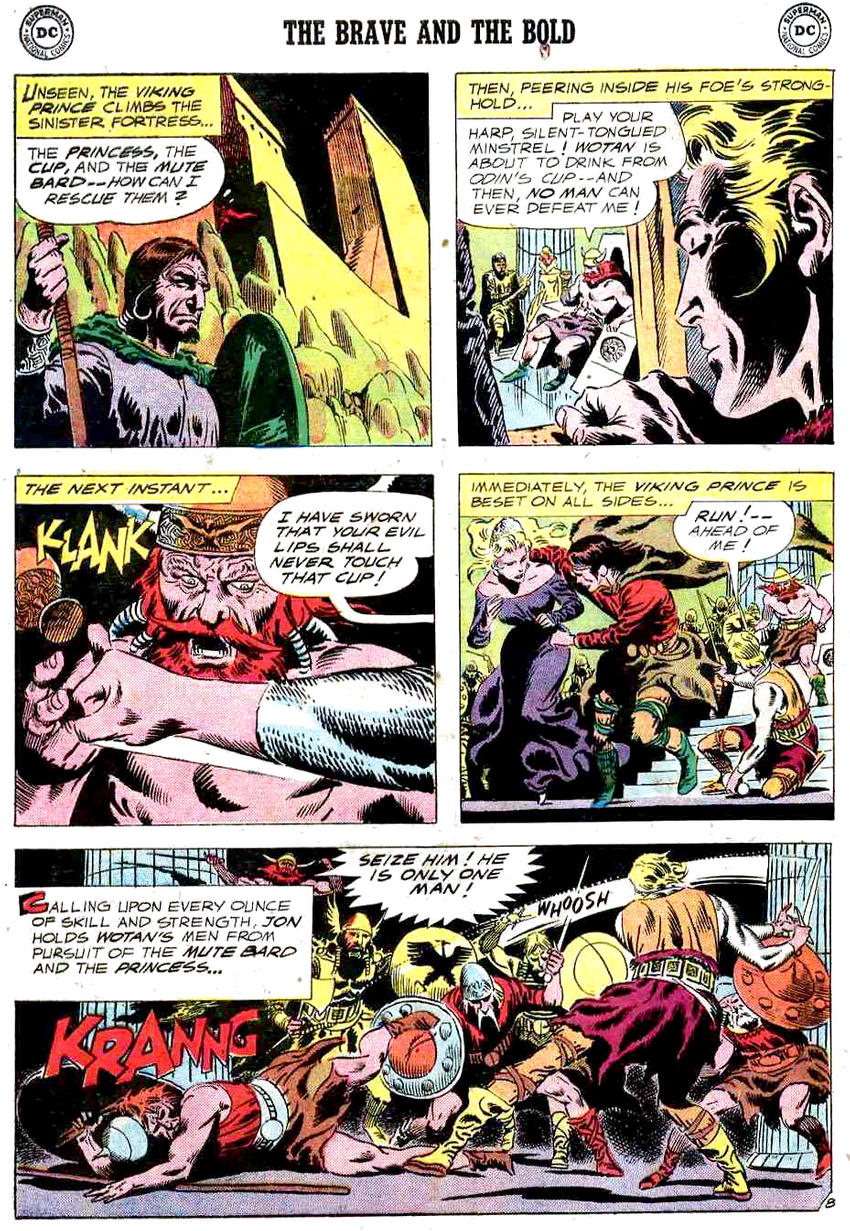
The Viking Prince feature, which ran in The Brave and the Bold for the first two dozen issues in the mid-to-late fifties, is a collaboration between Robert Kanigher and Joe Kubert. I believe the Viking Prince was a version of Hal Foster’s Prince Valiant, although the comic book character was original enough in his own right. Being written by Kanigher in the Comics Code era meant that the blood and thunder was not in violent battles between humans, but often with supernatural entities, like the living giant stone statue in “The Secret of Odin’s Cup!” Kubert’s art on the story is superb.

From The Brave and the Bold #20 (1958):


More about

Number 1565: Giving 3-D a Whack

Người đăng: Unknown on Thứ Sáu, 25 tháng 4, 2014

Three dimensional comic books and movies were a quick-moving fad in 1953, and the story is told that only the first 3-D comic book (Mighty Mouse from St. John) actually made money. Other publishers jumped in on the fad, only to lose money.

Whack #1, also from St. John, was not only a 3-D comic, but an attempt to cash in on the success of EC’s Mad. To be fair, EC put out a couple of 3-D comics to compete with St. John. But with the 3-D fad finished, Whack lasted one issue as a 3-D comic, then reverted to a 10¢ four-color format for two issues using stories prepared originally to be printed as 3-D.

Get out those red-blue anaglyphic glasses if you have them to see one of Whack’s attempts at humor and satire with the story, “Ghastly Dee-fective Comics” drawn by Norman Maurer and inked by Joe Kubert. It’s scanned from my copy of Whack #1. If you don’t have the red-and-blue lenses you can read the story in a black line version, directly below the 3-D version. It was prepared by a fan and posted online. By now the ink on all fifties 3-D comics has pretty much faded so the conversion isn’t perfect, but my thanks to that person anyway for their trouble.

If you would like to know how to make your own 3-D glasses. Click on the thumbnail, a link to an article from Boy’s Life to tell you how.


Following that is one of the stories prepared for 3-D but instead printed in standard comic book format. It’s by Kubert, inked by Maurer. The claim in the story, belied by having to print it in four colors rather than 3-D, is that the 3-D comics were best sellers. For me it’s of interest because it has caricatures of Kubert and Maurer, and even their boss, Archer St. John, as “St. Peter.”




More about

Number 1552: The man who milked spiders for gold

Người đăng: Unknown on Thứ Tư, 2 tháng 4, 2014

(You’re right if you think I showed another “SMACKO!” panel recently. It was in a Green Mask story I showed on February 21.)

Drawn by a teenaged Joe Kubert, this story uses the locale of Death Valley, California, which became a National Park in 1933. Death Valley, according to a little research on the Internet, was named by prospectors who crossed while traveling to the California gold fields in 1849, and yes, there was also gold in Death Valley, just as this story claims.

With a little more checking, I found the part of the story about using spiderwebs for crosshairs in bomb sights is true. You can read about it here. The story is entertaining as well as educational. And of course Joe’s artwork is always worth a look

From Harvey Comics’ All-New Comics #9 (1944):


***********

A story, with original artwork by Kubert, from another issue of All-New Comics:


More about

Number 1493: Spirit of the haunted house

Người đăng: Unknown on Thứ Sáu, 20 tháng 12, 2013

This Spirit episode was originally published in its newspaper Comic Book Section on December 12, 1940. It was reprinted in Police Comics #19 in 1943, which is the source of my scans. An interesting sidelight to this moody and effective story of an old dark house on a bleak and rainy night, is that the Grand Comics Database credits Joe Kubert with the coloring. Yes, that Joe Kubert. The GCD doesn't distinguish between the original and the reprint when reporting Kubert as colorist, but I’ll assume they mean the reprint. Joe was 16-years-old at the time.

Another item of interest for you Marvel Comics fans: Sam Rosen, a familiar name from countless comics of the 1960s, is credited with the lettering.


More about