Hiển thị các bài đăng có nhãn Julius Schwartz. Hiển thị tất cả bài đăng

Number 1610: Flying gorillas from outer space!

Người đăng: Unknown on Thứ Hai, 28 tháng 7, 2014

Last week I showed some gorilla horror stories, and now a gorilla science fiction tale from DC. Flying monkeys have been around since the Wizard of Oz, but flying King Kong-sized gorillas, well, that's new.

Not only are they flying giant gorillas, they come from a planetoid which has parked itself in Earth’s sky so the flying giant gorillas can steal our atmosphere. Atom bombs can’t stop them, so our scientists use fear gas* on them. What a crazy plot.

Script is by Gardner Fox. Fox wrote it for editor Julius Schwartz, who used high concepts when planning out stories for his magazines. It’s drawn by Carmine Infantino and Murphy Anderson, and it appeared originally in Strange Adventures #125 (1961). The striking cover is by Sid Greene.


I bought this issue of Strange Adventures when it came out. As goofy as the story is, and despite my love for gorilla-fiction, what I remember most about the comic were the full page ads that heralded Joe Kubert’s Hawkman and the first full-length Aquaman comic.


*There really is such a thing as fear gas, although that name implies that is the gas’s sole effect. It does a lot more damage than that. You can read about it here.

UPDATE: I found this incredible Chinese fireworks package  on the Design/Destroy website a few days after posting the story. I love a coincidence.


More about

Number 1403: Other Earths

Người đăng: Unknown on Thứ Tư, 17 tháng 7, 2013

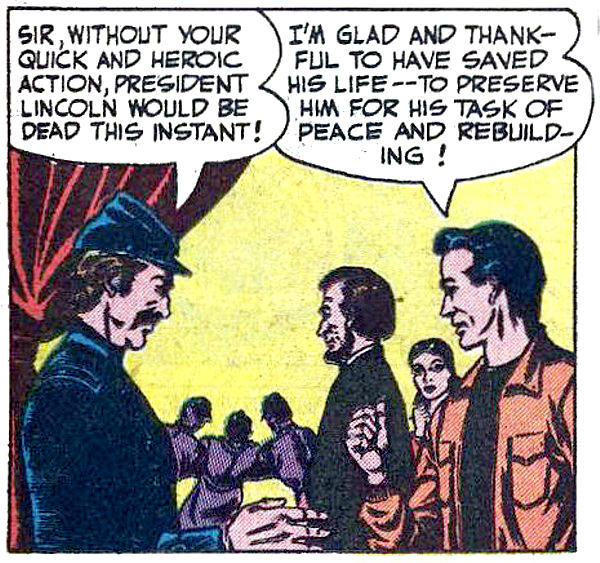
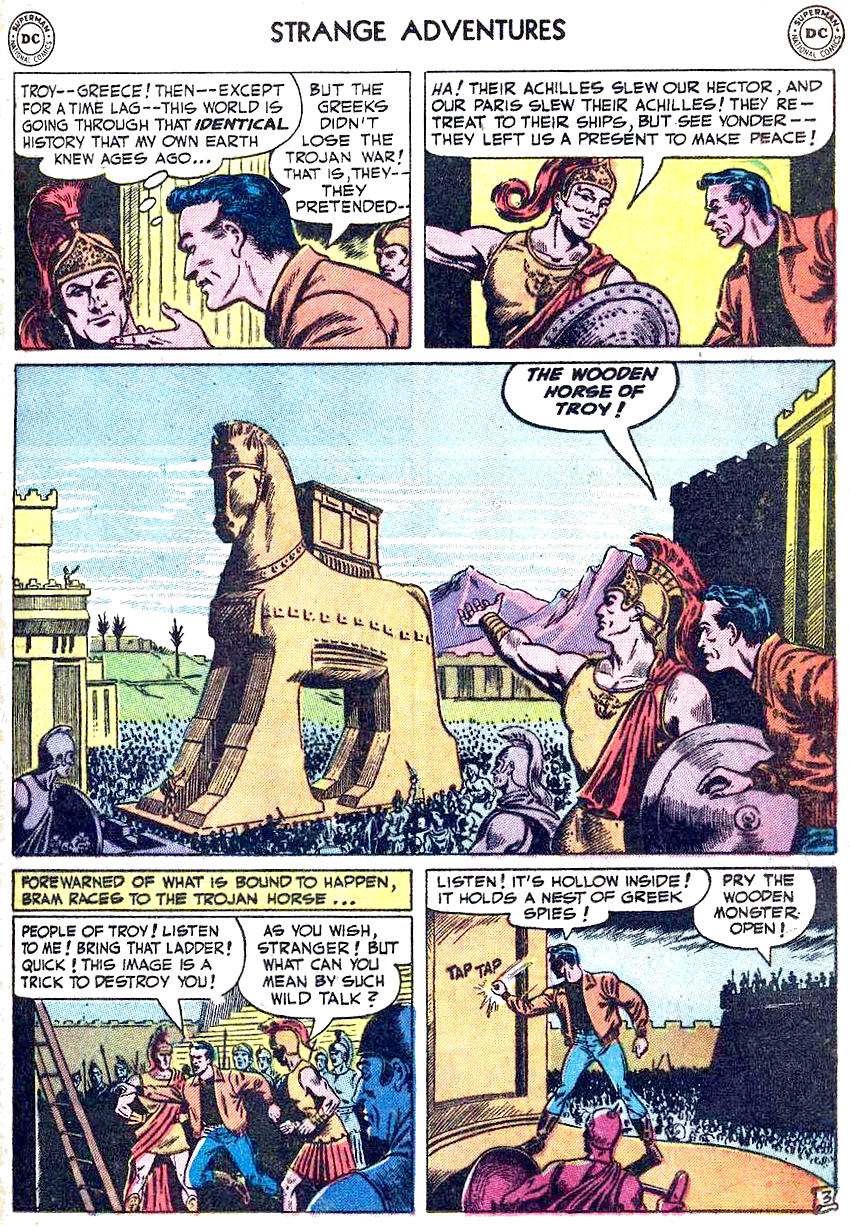
Bram Hilton zips along through space at one million light years per second in his intergalactic bell jar. I assume he needs to go that fast because the bell jar is small with no refrigerator, microwave oven, wet bar or toilet, and he probably needs a lot of rest stops. What he's looking for with a “vibration-duplicator” guiding him are other Earths that are like our planet, just in different phases of time. He ends up in Troy and at the Lincoln assassination. Pretty good timing for taking vibration-duplicator potluck!

Murphy Anderson drew this story for Strange Adventures #10 (1951), and the writing is credited on the splash page to Manly Wade Wellman. Wellman wrote science fiction and fantasy for several decades, and I have read many of his stories and books. I don’t recall any of his prose fiction being as oddball as this comic book story, and I attribute that to editor Julius Schwartz handing him a plot to work from, and having Wellman do his best to make sense of it.


More about

Number 1251: Phantom Stranger makes his debut

Người đăng: Unknown on Thứ Sáu, 26 tháng 10, 2012

The Phantom Stranger has a whole history with DC Comics, encapsulated in this Wikipedia entry. For our purposes today we're ignoring all of that to show you the first Phantom Stranger story from The Phantom Stranger #1 (1952).

[SPOILER ALERT] This is shown with a caveat: it's a story that appears to be supernatural but is shown to be a hoax. That was a basic trademark of DC's mystery comics line, which during the horror comics fad of the early '50s fell short of horror due to the debunking done in virtually every horror story. There's a fictional tradition of this type of mystery, and while a gimmick, it's a clever gimmick. For those who prefer their supernatural straight with no twists at the end to spoil the illusion, years later DC went full-bore into the supernatural, including the stories featuring this character.[END OF SPOILER]

This first series featuring The Phantom Stranger had a short run, just six issues. It was edited by Julius Schwartz.

This story is written by long-time DC scripter John Broome, and is drawn by Carmine Infantino and Sy Barry.


More about

Number 1213: The short Danger Trail

Người đăng: Unknown on Thứ Hai, 20 tháng 8, 2012

DC's Danger Trail lasted five issues, from #1, dated Jul-Aug 1950 to #5, Mar-Apr 1951. I have no idea why it had such a short life. It had good covers and interior art, and interesting characters in action-filled stories of intrigue. The artists, among them Carmine Infantino and Alex Toth, were some of DC's best. I don't know if sales were bad, or because editor Julius Schwartz was debuting a new title, Strange Adventures, with a first issue dated Aug-Sep 1950. In the wings was a sister publication, Mystery In Space, the first issue dated Apr-May 1951, which coincided with the last issue of Danger Trail. Science fiction was Schwartz's entry into magazine editing, after all. Read more about editor Julius Schwartz.

King Faraday, starring in this Robert Kanigher-scripted story from Danger Trail #2 (1950), had an even shorter career than the comic book. He appeared in the first four issues. He was brought back years later by DC in one of their revisionist versions of old and obscure characters, but that’s outside the scope of this blog. The story I'm showing here is a little caption heavy, but well drawn by Infantino and Frank Giacoia.


More about

The Flash's Final Fling--Twice

Người đăng: Unknown on Thứ Tư, 7 tháng 12, 2011

Here's a real oddity from DC's Silver Age. In March, 1966, Flash #159 bore this cover:
That's something of an unusual cover for DC; we'd expect to see it more from Marvel (as indeed we did several times in Spiderman). But more unusual still was seeing this cover on the next regular issue of the Flash, #161 (#160 was an 80-Page Giant):
Notice, down at the bottom, that Julius Schwartz was advertising another, completely different story, also based on the cover from #159. As the splash page notes:
A couple of comments before I proceed with the review. First, it's worth noting that neither story was written by the Flash's main writer, John Broome. The first version was scripted by Gardner Fox, while the second was contributed by Bob Kanigher. Second, the stories amount to breaking the fourth wall, as announcing that you're publishing a second story based on the cover is admitting that these are fictional stories.

The Fox story starts with Kid Flash and Barry Allen visiting the offices of Dr McNider (aka Dr Midnight), an Earth-Two physician. The doc is pleased to see the Earth-One heroes, but he wonders why Barry's not in his uniform. It turns out that the Flash is no more, because he feels underappreciated:
Dr McNider puts him under and probes to find out the real answer:
It turns out that a future criminal with the improbable name of Frand Mattar had sent a bomb back in time to Central City in 1966, which would explode if a high-speed wave hit it; Mattar had a trigger that would cause this to happen and was blackmailing the authorities to force them to allow him to loot at will. Of course, there was another thing that could cause the bomb to go off; if the Flash traveled at super-speed. Thus the "chronal officer" had hypnotized Barry to make him believe that nobody in Central City appreciated his efforts, so that he would resign.

Armed with this knowledge, Flash and his junior partner travel to the future, defeat Frand Mattar, and return to 1966 just in time to prevent the bomb explosion from destroying the city. Flash gets banner headlines and the key to the city, showing that he is still Central City's hero.

Comments: Some tricky time paradox problems with this story. Wouldn't the future world know that the Flash had saved the city? And why would Frand Mattar send a bomb into the past in the first place (other than to provide Fox with a rationale for the cover)? Wouldn't a bomb about to affect a city in 3780 be more compelling to the people of that era?

However, the Fox effort is a masterpiece compared to the second story. Kanigher compares Flash's relationship with his uniform to that of a soldier and his gun.
Whaaaaat? And even more oddly, Kanigher has the uniform answer:
The scene shifts to the day of Barry and Iris' wedding. Iris has planned things so that even her perennially late boyfriend will arrive on time; she has told him the nuptials take place an hour before the actual scheduled time. But as Barry is walking to the church he spots a super-speed turtle (no, I am not kidding):
He finds himself in a super-speed dimension, where ironically that turtle is considered quite slow. But when he travels back to our dimension, he discovers:
Iris breaks off with Barry, and in the days that follow, he begins to feel like his costume has ruined his life. So he discards it:
He visits Iris in the secluded cabin where they had planned their honeymoon, but when he arrives she is being menaced by a giant bear. He tries to save her without using his super-speed, but is kayoed by the grizzly. Fortunately, it turns out that the bear is a retired circus performer. However, Iris is not thrilled at Barry's effort, and indeed, compares him unfavorably to the Flash. Barry returns to Central City, where his uniform, discovered by a passing hitchhiker, is on display at the Flash Museum:
Moved, Barry puts on the uniform again, just as Iris enters the room, followed shortly by some crooks.  As the Flash, he quickly corrals the villains.  But now Iris will know his secret identity, right?  Well, no:
Cue happy ending, with Barry back as the Flash and Iris back in love with him.

 Comments: Sweet jeebus, this is a wacky story!  Kanigher's anthropomorphizing inanimate objects works in the war stories, but it is wildly out of place here.  One thing that I do find interesting is that Kanigher gives Barry a better reason for quitting (and one that is more in line with what Lee would do with Spiderman a year later in ASM #50).
More about