Home » All posts
Maybe It Was the 30th Century "Special" Science Fair?
Người đăng: Unknown on Thứ Hai, 13 tháng 2, 2006
Worst. Swipe. Ever.
Người đăng: Unknown on Thứ Sáu, 10 tháng 2, 2006
Adventure #244 (Jan 1958) is not a famous issue, but it does have some historical significance. One of the backup features in Adventure at the time was Green Arrow, and the story in that issue was “A Medal for Roy”. It’s kind of a puzzle story; how can Green Arrow and Speedy overcome an obstacle?
Speedy is chased by some crooks into Oliver Queen’s apartment. Quickly changing into Roy Harper, he diverts and then subdues them. Because he had “rescued” Speedy from those crooks, the President (Eisenhower at the time) wanted to bestow a medal on him. Unfortunately Roy also has to be present as Speedy at the same time for a police lineup. How can he possibly skip either event?
In the end, Speedy hits on an ingenious solution. He tells the President of the United States about his predicament and the President’s grandson (David) agrees to impersonate Speedy while Roy accepts the award. Roy explains it to Ollie here:

Cute little idea for a story, and six years later DC decided to dust off the plot for another story, with disastrous results.
Setting: Action #309, February 1964. Superman is faced with the same dilemma as Roy Harper was; he must appear as both Supes and Clark at the same time. His robots are kayoed by solar flares, Batman has to appear himself at the function. So, after casting about for a solution, he comes up with the answer:

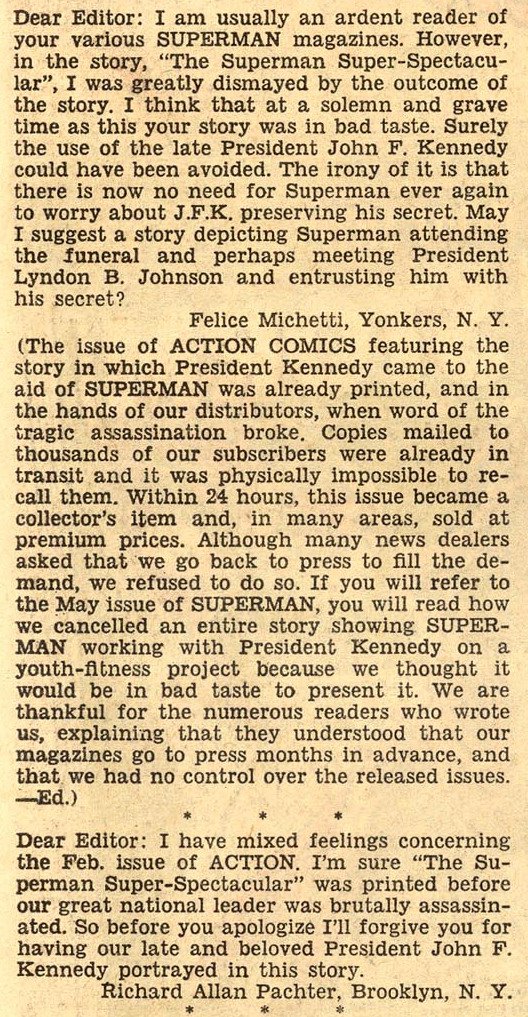
But there was one horrific problem for DC: the comic came out a little over a month after the assassination of President Kennedy. Of course, it had been written and drawn and sent to the printer well before the events of November 22, 1963, but inevitably DC took some flack:

Incidentally, the story that was canceled was later uncancelled and printed as a tribute to JFK in Superman #170:

Update: Note that Roy gets it grammatically correct, while Superman errs; it's "Whom can you trust?" As an aside to make this story even a little more bizarre, back around 1970 my parents went down to Mexico for a business trip. When they returned they brought us kids small gifts; mine were two Mexican comic books. One was labeled SuperComic, and apparently consisted of reprints of older DC comics. As it happened, this particular issue reprinted Action #309, which gave me quite a start, as they had not redrawn the face of the president. I couldn't help but ponder the thought of Mexican kids coming to those last few panels, seven years after the events in Dallas and what they must have thought. Caramba!
More about →
Speedy is chased by some crooks into Oliver Queen’s apartment. Quickly changing into Roy Harper, he diverts and then subdues them. Because he had “rescued” Speedy from those crooks, the President (Eisenhower at the time) wanted to bestow a medal on him. Unfortunately Roy also has to be present as Speedy at the same time for a police lineup. How can he possibly skip either event?
In the end, Speedy hits on an ingenious solution. He tells the President of the United States about his predicament and the President’s grandson (David) agrees to impersonate Speedy while Roy accepts the award. Roy explains it to Ollie here:

Cute little idea for a story, and six years later DC decided to dust off the plot for another story, with disastrous results.
Setting: Action #309, February 1964. Superman is faced with the same dilemma as Roy Harper was; he must appear as both Supes and Clark at the same time. His robots are kayoed by solar flares, Batman has to appear himself at the function. So, after casting about for a solution, he comes up with the answer:

But there was one horrific problem for DC: the comic came out a little over a month after the assassination of President Kennedy. Of course, it had been written and drawn and sent to the printer well before the events of November 22, 1963, but inevitably DC took some flack:

Incidentally, the story that was canceled was later uncancelled and printed as a tribute to JFK in Superman #170:

Update: Note that Roy gets it grammatically correct, while Superman errs; it's "Whom can you trust?" As an aside to make this story even a little more bizarre, back around 1970 my parents went down to Mexico for a business trip. When they returned they brought us kids small gifts; mine were two Mexican comic books. One was labeled SuperComic, and apparently consisted of reprints of older DC comics. As it happened, this particular issue reprinted Action #309, which gave me quite a start, as they had not redrawn the face of the president. I couldn't help but ponder the thought of Mexican kids coming to those last few panels, seven years after the events in Dallas and what they must have thought. Caramba!
Herbie
Người đăng: Unknown on Thứ Tư, 8 tháng 2, 2006
Of all the Silver Age characters, Herbie Popnecker is undoubtedly one of the most unusual. The 1960s, when Herbie became a surprise hit, were all about cool, with James Bond and Joe Namath setting the style. Herbie was the anti-cool; homely, fat, and none too athletic (apparently). His long-suffering father despaired that Herbie would ever be a useful member of society; as he put it, his son was a "little, fat nothing!"
But what Mr Popnecker didn't know was that Herbie was secretly one of the most famous young men in the world, a confidant of Lyndon Johnson and Nikita Kruschev (and adored by Ladybird Johnson as well). Herbie's secret weapon was his apparently infinite assortment of lollipops, which contained amazing powers. There were time travel lollipops, anti-gravity lollipops, invisibility lollipops, super-hole digging lollipops ...you get the idea.
And Herbie himself could do lots of amazing things. For example, he could fly, he could talk to animals, he could perform an endless variety of magic tricks. He could make himself invisible, or turn himself into a wraith. He could catch bullets with his teeth, or just let them bounce off him like Superman.
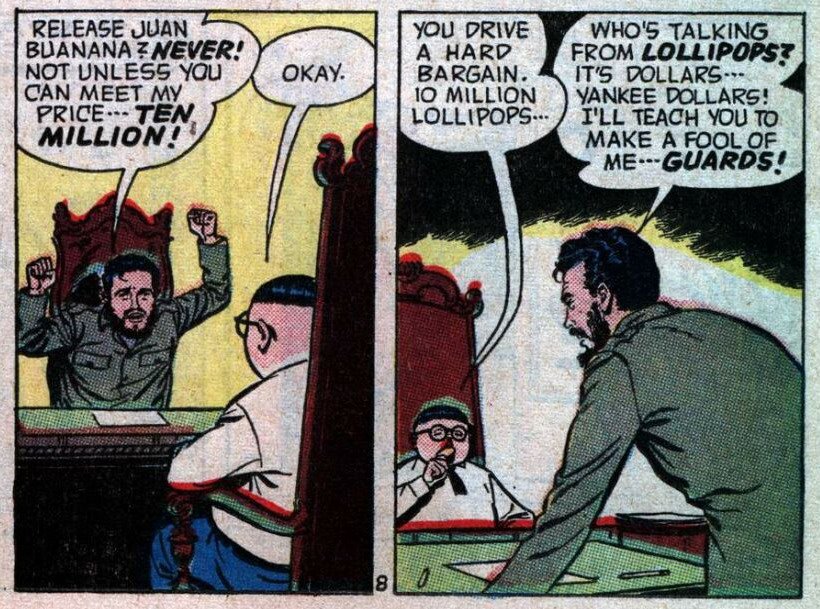
One interesting aspect of Herbie was that he lived in the real world. In most comics of the time, characters might face famous real world characters, but usually their names were slightly altered to avoid lawsuits. Herbie met lots of real people who had their real names. In Herbie #1, for example, he encounters Fidel Castro:

Every woman he met found him irresistable, including some rather famous married gals:

There are some obvious reasons why Herbie was so popular. While every boy hoped they'd grow up into another James Bond, it was nice to see Herbie around to say that there was a wide range of men that women found attractive. You could argue it was the beginning of geek chic. It made no sense that Herbie would be the most famous person on Earth and yet a schlub to his dad, but of course that was part of the charm. We all thought we were superstars that our family didn't recognize yet as such.
Herbie's favorite saying was "You want I should bop you with this here lollipop?" And that was pretty loquacious for Herbie, most of the time he confined himself to terse commands and observations.
More about →
But what Mr Popnecker didn't know was that Herbie was secretly one of the most famous young men in the world, a confidant of Lyndon Johnson and Nikita Kruschev (and adored by Ladybird Johnson as well). Herbie's secret weapon was his apparently infinite assortment of lollipops, which contained amazing powers. There were time travel lollipops, anti-gravity lollipops, invisibility lollipops, super-hole digging lollipops ...you get the idea.
And Herbie himself could do lots of amazing things. For example, he could fly, he could talk to animals, he could perform an endless variety of magic tricks. He could make himself invisible, or turn himself into a wraith. He could catch bullets with his teeth, or just let them bounce off him like Superman.
One interesting aspect of Herbie was that he lived in the real world. In most comics of the time, characters might face famous real world characters, but usually their names were slightly altered to avoid lawsuits. Herbie met lots of real people who had their real names. In Herbie #1, for example, he encounters Fidel Castro:

Every woman he met found him irresistable, including some rather famous married gals:

There are some obvious reasons why Herbie was so popular. While every boy hoped they'd grow up into another James Bond, it was nice to see Herbie around to say that there was a wide range of men that women found attractive. You could argue it was the beginning of geek chic. It made no sense that Herbie would be the most famous person on Earth and yet a schlub to his dad, but of course that was part of the charm. We all thought we were superstars that our family didn't recognize yet as such.
Herbie's favorite saying was "You want I should bop you with this here lollipop?" And that was pretty loquacious for Herbie, most of the time he confined himself to terse commands and observations.
A Salute to Batman Annual #1
Người đăng: Unknown on Thứ Ba, 7 tháng 2, 2006
In the summer of 1960, DC released Superman Annual #1. The significance of this issue cannot be overstated. I don't believe that DC had ever reprinted an entire story exactly as it had been previously published (with the arguable exception of the Superman story in Action Comics #1, which had appeared in Superman #1 with panels that had been cut from the original story to make it fit).
It must have been successful enough because in the summer of 1961, DC followed up with Batman Annual #1. This is one of the greatest comics ever assembled, a selection of stories brilliantly chosen to introduce the reader to the Batman saga.
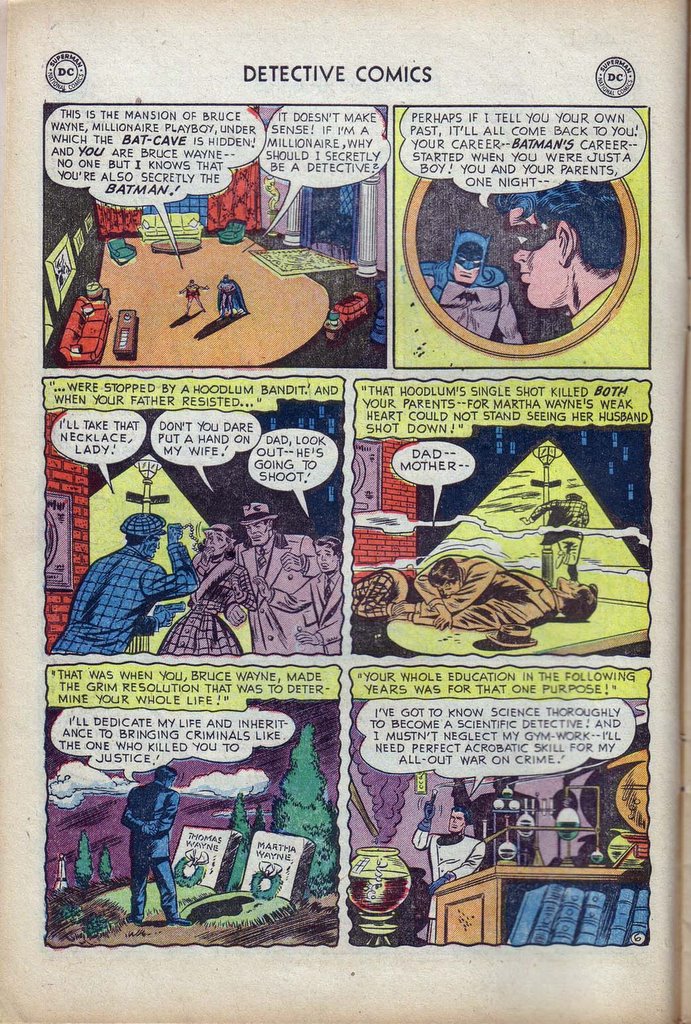
First things first, how about explaining the origin of the Batman? But rather than explain the origin in a boring, straightforward fashion, the story How To Be the Batman from Detective #190 was used. In this story, Batman is hit by a ray that causes amnesia, and Robin must explain the origin:

(Scan from Detective #190)
It's a superb retelling of the origin as a flashback sequence. The rest of the story has Robin teaching Batman (and the reader) about his crimefighting techniques.
The second story is The Strange Costumes of Batman reprinted from Detective #165. This excellent Dick Sprang story features Batman wearing suits that are made of asbestos, that contain glider wings, and even one with a scuba outfit. As became cliche in these stories, there is one mystery item that we are told must never be used, and which must therefore be used before the end of the story (you think the Batman writers read Chekov?):

The next story was Untold Tales of the Bat-Signal from Detective 164, which continues the discussion of Batman's arsenal of crime-fighting equipment, followed by The Origin of the Bat-Cave, a time-traveling tale from Detective #205 where Batman and Robin help out a colonial-era frontiersman who spies on the "savages" in order to learn their plans to attack the settlements.
This was followed by Batman's Electronic Crime-File (original title The 10,000 Secrets of Batman), an early example of a simple computer database in action (actually a card sorter). Because he has no super powers, Batman has always been at the forefront of innovation in crime-fighting tools.
Rounding out the book are two more tales showing off different aspects of Batman and Robin. Thrilling Escapes of Batman and Robin and The Amazing Inventions of Batman show the dynamic duo in action.
More about →
It must have been successful enough because in the summer of 1961, DC followed up with Batman Annual #1. This is one of the greatest comics ever assembled, a selection of stories brilliantly chosen to introduce the reader to the Batman saga.
First things first, how about explaining the origin of the Batman? But rather than explain the origin in a boring, straightforward fashion, the story How To Be the Batman from Detective #190 was used. In this story, Batman is hit by a ray that causes amnesia, and Robin must explain the origin:

(Scan from Detective #190)
It's a superb retelling of the origin as a flashback sequence. The rest of the story has Robin teaching Batman (and the reader) about his crimefighting techniques.
The second story is The Strange Costumes of Batman reprinted from Detective #165. This excellent Dick Sprang story features Batman wearing suits that are made of asbestos, that contain glider wings, and even one with a scuba outfit. As became cliche in these stories, there is one mystery item that we are told must never be used, and which must therefore be used before the end of the story (you think the Batman writers read Chekov?):

The next story was Untold Tales of the Bat-Signal from Detective 164, which continues the discussion of Batman's arsenal of crime-fighting equipment, followed by The Origin of the Bat-Cave, a time-traveling tale from Detective #205 where Batman and Robin help out a colonial-era frontiersman who spies on the "savages" in order to learn their plans to attack the settlements.
This was followed by Batman's Electronic Crime-File (original title The 10,000 Secrets of Batman), an early example of a simple computer database in action (actually a card sorter). Because he has no super powers, Batman has always been at the forefront of innovation in crime-fighting tools.
Rounding out the book are two more tales showing off different aspects of Batman and Robin. Thrilling Escapes of Batman and Robin and The Amazing Inventions of Batman show the dynamic duo in action.
Launch Pad
Người đăng: Unknown on Chủ Nhật, 5 tháng 2, 2006
Showcase was probably the most important DC magazine of the late 1950s and early 1960s. It was intended to showcase new comic characters to see if teenage boys would buy them before launching a new book.
The first three issues featured Firefighters, Kings of the Wild, and Frogmen. Apparently none of them struck a chord with the public but the fourth issue hit the jackpot:
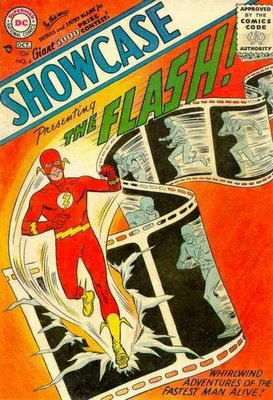
The Flash had been a Golden Age character, but this was the new Flash. Where Jay Garrick had been a research scientist with his own laboratory, Barry Allen was a police scientist. Barry wore a face-covering mask, while Jay had simply worn a helmet and vibrated a bit so his features were blurred.
After Showcase #5, featuring Manhunters, Showcase went on a remarkable run. Starting with #6's Challengers of the Unknown, every feature published in Showcase up until #40 graduated to either its own magazine or (in the cases of Adam Strange and Space Ranger), became cover features in other DC magazines. In rapid order, the DC cover stars of the 1960s appeared: Flash, Challengers of the Unknown, Lois Lane, Space Ranger, Adam Strange, Rip Hunter Time Master, Green Lantern, Sea Devils, Aquaman, Atom and Metal Men. Flash lasted for 246 issues, Challengers for about 80, Lois Lane for about 130, Rip Hunter for 30, Green Lantern for 90, Sea Devils 35, Aquaman 56, Atom 45 and Metal Men 45.
After that, either DC's ideas began to run out, or Marvel began cutting into the sales, or (my opinion), DC stopped trying to create new superhero titles. From 41-54, none of the features were deemed worthy of continuing. Tommy Tomorrow (a DC sci-fi hero since the 1940s) was given the big treatment in 41, 42, 44, 46 and 47. Issue #43 was a one-shot Dr No (had DC gotten rights to the movie without real rights to James Bond?). #45 featured Sergeant Rock, who of course was already a cover feature in Our Army at War. Issues #48, 49 and 52 featured Cave Carson, a spelunker who mostly battled weird monsters inside earth and who had already a pair of tryout trilogies in Brave & Bold.
And even when it went back to featuring superhero debuts, Showcase did not get its mojo back. Aside from the Teen Titans (who had effectively debuted in Brave & Bold although they were not called that), and the Phantom Stranger, none of the characters featured in the rest of the run of Showcase lasted for more than ten issues of their own mag, and most didn't even manage to get off the launchpad. Consider these features: B'wana Beast, the Maniaks, Johnny Double, The Creeper, Anthro, Hawk & Dove, Bat Lash, Angel & Ape, Dolphin, Firehair, Jason's Quest, Manhunter 2070
More about →
The first three issues featured Firefighters, Kings of the Wild, and Frogmen. Apparently none of them struck a chord with the public but the fourth issue hit the jackpot:

The Flash had been a Golden Age character, but this was the new Flash. Where Jay Garrick had been a research scientist with his own laboratory, Barry Allen was a police scientist. Barry wore a face-covering mask, while Jay had simply worn a helmet and vibrated a bit so his features were blurred.
After Showcase #5, featuring Manhunters, Showcase went on a remarkable run. Starting with #6's Challengers of the Unknown, every feature published in Showcase up until #40 graduated to either its own magazine or (in the cases of Adam Strange and Space Ranger), became cover features in other DC magazines. In rapid order, the DC cover stars of the 1960s appeared: Flash, Challengers of the Unknown, Lois Lane, Space Ranger, Adam Strange, Rip Hunter Time Master, Green Lantern, Sea Devils, Aquaman, Atom and Metal Men. Flash lasted for 246 issues, Challengers for about 80, Lois Lane for about 130, Rip Hunter for 30, Green Lantern for 90, Sea Devils 35, Aquaman 56, Atom 45 and Metal Men 45.
After that, either DC's ideas began to run out, or Marvel began cutting into the sales, or (my opinion), DC stopped trying to create new superhero titles. From 41-54, none of the features were deemed worthy of continuing. Tommy Tomorrow (a DC sci-fi hero since the 1940s) was given the big treatment in 41, 42, 44, 46 and 47. Issue #43 was a one-shot Dr No (had DC gotten rights to the movie without real rights to James Bond?). #45 featured Sergeant Rock, who of course was already a cover feature in Our Army at War. Issues #48, 49 and 52 featured Cave Carson, a spelunker who mostly battled weird monsters inside earth and who had already a pair of tryout trilogies in Brave & Bold.
And even when it went back to featuring superhero debuts, Showcase did not get its mojo back. Aside from the Teen Titans (who had effectively debuted in Brave & Bold although they were not called that), and the Phantom Stranger, none of the characters featured in the rest of the run of Showcase lasted for more than ten issues of their own mag, and most didn't even manage to get off the launchpad. Consider these features: B'wana Beast, the Maniaks, Johnny Double, The Creeper, Anthro, Hawk & Dove, Bat Lash, Angel & Ape, Dolphin, Firehair, Jason's Quest, Manhunter 2070