Người đăng: Unknown on Thứ Sáu, 11 tháng 8, 2006

Number 9

COVERING IT: Classic Golden Age Comic Book Covers, Part II.

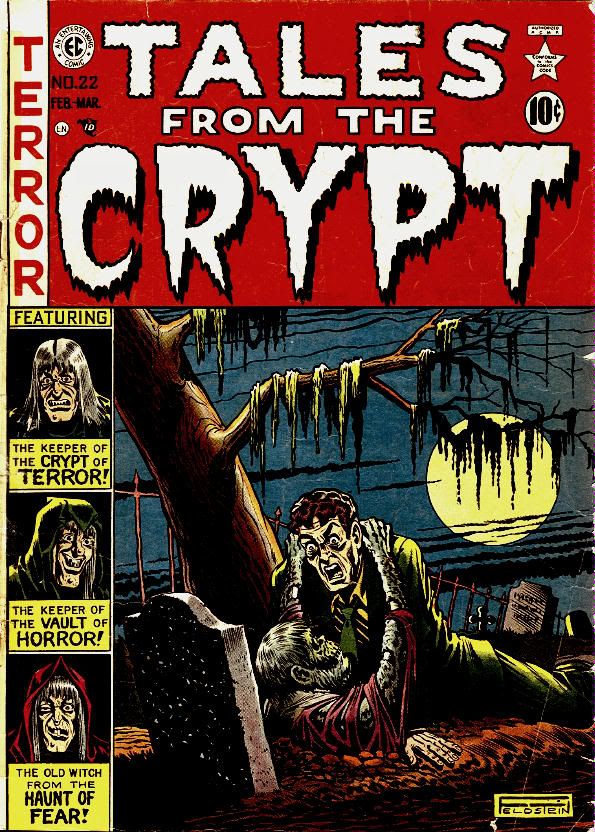
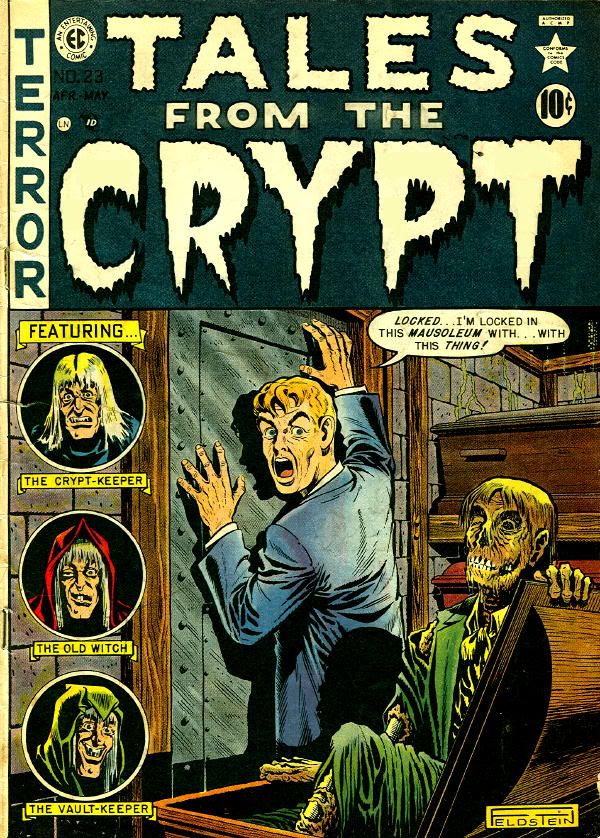
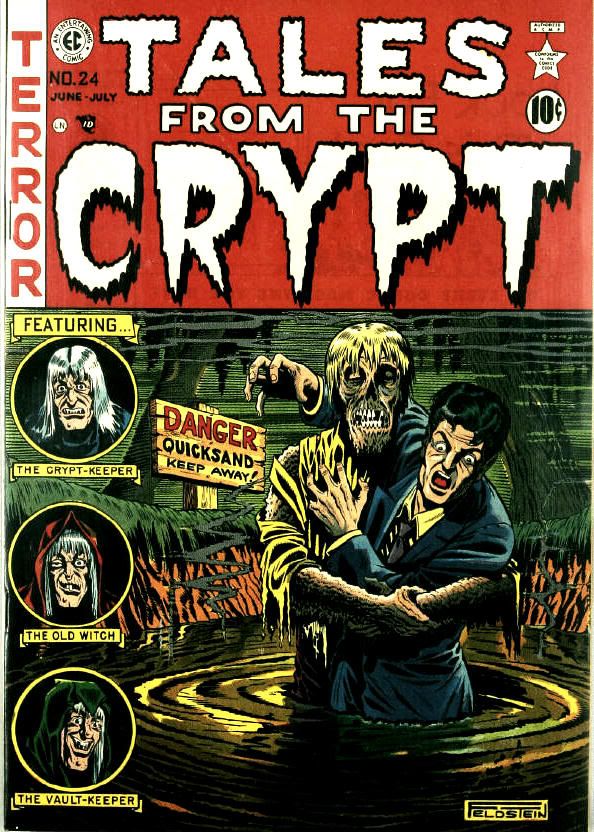
These three classic covers of Tales From The Crypt, all drawn by editor/artist Al Feldstein, form a terrifying triptych of living guys and living dead guys.

These sent shivers through readers encountering these comic books for the first time in the early 1950s. They sent shivers of pleasure through me when I saw them for the first time ten years after their original publication. "These are neat-o," I thought, in my own unoriginal but expressive adolescent way.


Click here for full-size image. (204K)

Two of these covers (#22 and #23) are from my collection, and #24 is taken from the Internet. I was impressed by the lead story in #23, written and drawn by Feldstein, called "Reflection of Death." I first saw it in a Ballantine paperback reprint in 1964. The story embodies (get it? bodies?) those elements which brought EC Comics fame and infamy: graphic images of rotting corpses, lurching around in a grotesque parody of life. Booo-hahaha! I loved it then, I love it now.


Click here for full-size image. (217K)

Of the three covers, #24 seems to be the weakest, and not because of the drawing, which is typical Feldstein, straight to the point. Even though his figures were stiff (and his stiffs were figures!) his sense of design and graphic simplicity, with bold inking, made his covers stand out on the crowded newsstands. No, the reason I think it's the weakest is because when examining the cover, even when factoring in the you're-never-gonna-see-this-in-real-life sight of a corpse hauling a guy into a pool of quicksand, the victim isn't fighting back.


Click here for full-size image. (182K)

I don't know about you, but if some raggedy, stinking, rotting corpse was somehow brought to life and dragging me into a quagmire I'd be fighting back, with whatever means possible! I'd be scratching, kicking, punching and the whole time screaming like a little girl. I sure wouldn't have a neat suit and a tie that's still straight. By the time some zombie got me into the swamp we'd both be the worse for wear. I ain't going down without a fight, not even with a walking dead guy whose muscles have probably decomposed along with most of the rest of him.

Ah, but this is an EC COMIC, you say, and that excuses a lot. In EC Comics the writing was usually good enough, the plots compelling enough, the artwork sensational enough, that the reader would be sucked right into the fantasy. The best horror stories don't have to be probable, just carry their own kind of internal logic. It's kind of a satisfying fantasy, really--vengeance after death, that is--but it's available only in comic book stories like these. So once you get past that you can accept these stories as little cautionary tales, preaching to the readers in their own gruesome way that evil will be answered by evil. An eye-for-an-eye was never truer than in an EC Comic, where justice was done, even from beyond the grave.
More about →

Người đăng: Unknown on Thứ Ba, 8 tháng 8, 2006


Number 8

Don't Bury Me Deep

There's no room for subtlety in a 7-page comic book story, and especially no subtlety in a horror comic book story. Since the lead character is most likely going to get it in the end, it has to be made immediately known to the reader that whatever vengeance--from another character, or even from beyond the grave--is visited upon him, the butthead really deserves it.

"Don't Bury Me Deep" fits right into that category of horror story. It's drawn by Bill Everett, longtime stalwart of the Timely/Atlas Comics line, creator of Sub-Mariner, and illustrator of many a spooky tale for these Stan Lee edited books. It's from Adventures Into Weird Worlds #5.

Since "Don't Bury Me Deep" is about an undertaker, I hope you'll dig it. Har har har.


More about →

Người đăng: Unknown on Thứ Hai, 7 tháng 8, 2006

Number 7

It Rhymes With Lust

The Comics Journal did a gutsy thing by using 63 pages to reprint the 1950 Picture Novel, It Rhymes With Lust, in their latest issue, #277.

There are a couple of articles by Michael T. Gilbert and Ken Quattro giving the history of It Rhymes With Lust, a novel written by "Drake Waller," (pseudonyms of Leslie Waller and Arnold Drake). Reading about an old experiment in comics is different than seeing it. So it was great that TCJ decided to print the whole thing, and let the readers decide whether it qualifies as the first graphic novel.

It Rhymes With Lust was originally printed in black and white with color covers, in a format halfway between a paperback book and comic book. It reminded me of common black-and-white comics printed in Europe, of which I have a few. I'm not sure which came first, the Euro comics, or It Rhymes With Lust, but like any idea, it probably had several incarnations in different places, some more successful than others.

In his TCJ article about the book, Michael T. Gilbert describes the plot as akin to a "B-movie potboiler," which it was. That was probably one of the problems with it; it stuck too close to what was already being seen, both in movies and paperback books. Matt Baker, the artist, was closely associated with romance comics, so it had something of a romance comic feel. That was OK for luring in females to buy it. I just wonder if it worked. Obviously not enough people bought it, since the format was killed after one more experiment (a mystery called Case Of The Winking Buddha, with art by Charles Raab).

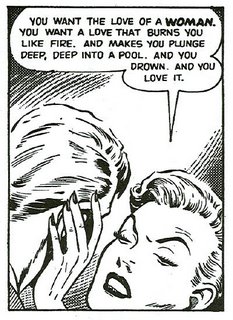
I'm including examples of a couple of panels from It Rhymes With Lust, which show that some of the dialogue was strictly from an author's imagination, and nothing anyone would say in real life, or even in a movie. Only in a comic book could you get a line that says, "By the god that made me!" instead of something like, "Goddam it!" I'm not advocating the use of swearing, but probably throwing in a couple of hells and damns might have made the novel seem more adult, more apart from the movies and color newsstand comic books it was inspired by.
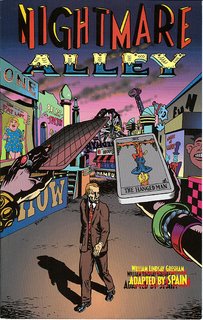
A couple of years ago, Fantagraphics, publisher of The Comics Journal, published a graphic novel version of Nightmare Alley, drawn by Spain Rodriguez, an interpretation of the popular noir novel and movie of the late 1940s. This is more of what I think the book It Rhymes With Lust could have and should have been: an earthier, sexier, tougher book by far than the half-wimpy but prettily illustrated black-and-white comic book it was.
Michael Gilbert found his copy of It Rhymes With Lust on the top shelf in a Powell's bookstore. My fantasy would be to be digging around Powell's and find a 1950 graphics novel version of Nightmare Alley, drawn by EC Comics great Graham Ingels, who would have been the perfect artist for that book. I'm allowed to dream about it, anyway.
More about →

Ultra, the Multi-Alien

Người đăng: Unknown on Chủ Nhật, 6 tháng 8, 2006

DC introduced a lot of weird characters in the late 1960s, but few of them were weirder than Ultra, The Multi-Alien. Ultra was Ace Arn, a space explorer from the near future, who was accidentally transformed into a freak with the composite powers and body of four different aliens. As was becoming common, some of the conflict in the story was actually internal; the hero was unhappy with being "different". See Ben Grimm (Thing), Metamorpho, the Doom Patrol and others. At first one of the agonies for him was the loss of his girlfriend, Bonnie Blake, but eventually she accepted him despite his strange appearance.

Ultra's powers were pretty basic--he could fly, had incredible strength in one arm, could shoot lightning and had magnetic powers as well. He first appeared in Mystery in Space #103, taking over the cover and feature slot from Adam Strange. There were eight appearances in all, with #110 spelling the end for both the Multi-Alien and Mystery in Space.

More about →

Người đăng: Unknown


Number 6

Jack Cole and Silver Streak, Part I


It's fun to go back and look at the early work of the really great cartoonists and comic book artists. By the mid-to-late 1940s Jack Cole had risen to a level of comic sophistication with Plastic Man that still holds up 60 years later. But his earlier work, while showing flashes of the brilliance to come, is really more routine, what was expected in comic books of the time. He even signed it with a pseudonym.

Silver Streak--a Flash-like superhero--was a character Cole worked on early in his comic book career. The book I scanned this story from is a 1946 reprint of some work from about 1940, which accounts for its look, passé by the time it was republished. Comics came a long way in a very short period of time as artists experimented and the public voted on what they liked with their dimes.

Still, this issue of Silver Streak, a one-shot with no number, is a good one. I ran across my copy over 25 years ago. It's in rough shape, with a cover and first few leaves detached, but it's scarce in any condition. I'm including the cover, which wasn't drawn by Jack Cole, but by another of my favorite Golden Age artists, Dick Briefer (creator of the funny Frankenstein). This is bondage, boys and girls. Get a good look at the lady tied up, being tortured by a machine that promises "worry" (the very fact of being on this device would cause at least that), "mild pain," "shooting pains," "severe headache," or even "unbearable agony." But wait, there's even worse than unbearable agony, which is "near death," and "death." Luckily Silver Streak is coming into the scene, feet-first, to rescue her. What I can't figure out is, why is the monster with the axe smiling at Silver Streak?


The Silver Streak episode here is the first in the reprint comic, but the fourth Silver Streak story overall. The Overstreet Comic Book Price Guide says it's the first story with Silver Streak in a new costume, and that may have had something to do with its choice as a reprint.

I'm assuming Cole wrote the stories in the book, but there's really no way to tell. You can tell Cole writing by his use of gag situations, but the use of a gag where the matronly woman calls him anything but "Silver Streak," wears thin as fast as Silver Streak can run. The villain is disappointing looking, with a lame name of "Doc." Like other early comic book stories the action is propelled instantly. No subtleties here. Superman by Siegel and Shuster was an early template for this story, where Silver Streak fights giant spiders, saves a tied-up girl (oboy! More bondage!) from a fiery doom, and even rescues a farm boy from crushing death by speeding car, all in 11 pages.

It's all pretty breathless and energetic stuff. As time goes on I'll be scanning and presenting the other three stories in the book.


More about →

Người đăng: Unknown on Thứ Năm, 3 tháng 8, 2006

Number 5
 
COVERING IT: Classic covers of Golden Age Comic Books, Part 1 Alex Schomburg

Alex Schomburg was a much sought after artist for various publishers in the comics industry during the forties. His artwork on the cover of a Golden Age probably sold more comic books than books with anyone else's artwork. In the case of Schomburg, you can judge a book by its cover, since the comic inside has little value without the cover!

In 1963 I bought a copy of All Select Comics #1. I bought it sight unseen through the mail. In those days no one published reproductions of covers, unless it was to trace them off on stencils for a spirit duplicator. Xerox machines were very uncommon, and photo-offset printing of a fanzine with something as eclectic as old covers would have been prohibitively expensive. So I had never seen the book and didn't know what I was in for when I opened the package.


For full-size image click here.

I was floored by the cover. I was in awe of the drawing, the activity going on, the giant figures of the super heroes. However, awesome turned to awful when I looked at the contents, which as I remember were a hurried and amateurish looking comic shop job. By the time this came out in the summer of 1943 all of the great artists were in the Army, I'm sure. I sold the book a year later for $4.75. Ouch.

A couple of years later I was in Berchtesgaden and visited what was called "Hitler's Tea Room," for lunch. I thought about this cover, wondering what the Germans around me would have thought if they'd seen it.

Schomburg gave equal time to the Japanese. The Timely superheroes were equal opportunity. They bashed everybody! While the Germans were depicted as stock caucasians, Japanese on the covers of comics fared poorly when depicted by any artist, not just Schomburg. They were usually so horribly caricatured that it's almost embarrassing now to look at them. Asians in general took a beating in comic book and comic strip art. They were either jug-eared, buck-toothed and goofy, or monkey-like in appearance. Racism against Asian races was rampant in America, and reared its head again during both the Korean and Vietnam conflicts.


For a full-size image click here.

I'm presenting this cover as an historical piece, not as any kind of agreement with its depictions of Japanese. And this was one of the milder Schomburg covers when it came to Japanese stereotypes.

Alex Schomburg was heavily in demand and did covers for several publishers. His drawing board must've been full of jobs during those war years. He usually did variations on a theme: some sort of sinister equipment, sometimes marked (Nipponese Earth-Boring Machine or some such nonsense), or as with the covers above, with swastika or Rising Sun prominent, and the heroes of that particular comic book publisher beating the snot out of the enemy. This was wartime with millions of men and women in uniform. Publishers just followed the trends and printed what at the time was morale-building and patriotic, and we should look at them as Americans did 60+ years ago, and not as how they look to us now.

Of the two covers, All Select #1 has to be one of my all-time favorite comic book covers by anyone, and I'm sure this issue flew off the stands when it appeared in 1943. The Overstreet Comic Book Price Guide describes it as "Classic Schomburg cover," and that would be a classic understatement.


More about →

Người đăng: Unknown on Thứ Ba, 1 tháng 8, 2006

Number 4

As a P.S. to my recent blog with the Basil Wolverton story, I'm adding this. The two issues of Graphic Story Magazine, #'s 12 and 14, that came out in 1970-71, were what opened my eyes to Wolverton's diversity as a cartoonist. Bill Spicer, the editor/publisher of Graphic Story Magazine, collected material from diverse places and people, and led to my understanding of Wolverton as both a respected cartoonist and also as a cult figure.

At the time of publication of the two issues of GSM Wolverton hadn't yet suffered his stroke and was creating covers for Plop!, a comic from DC, subtitled "The Magazine Of Weird Humor." Not too much of Plop! was all that humorous, weird or otherwise, but Basil's covers showed he was still as weird as ever, and as funny.

The two covers of Graphic Story Magazine show how much alike and how apart his art styles could be. They are both grotesque depictions of humans, but one is funny and how is gruesomely grim. That was Wolverton, and his work was instantly recognizable, no matter what genre he was drawing in at the moment.

For full-size image click here.


For a full-size image click here.

More about →