Người đăng: Unknown on Chủ Nhật, 23 tháng 9, 2007


Number 193


Miss Purdy loves Uranus


"Queen Of Uranus" comes from Forbidden Worlds #78 (1959). It's part of the Pappy tear sheet collection; a box of hundreds of loose pages of stories cut out of old comics, given to me in the early 1980s. I reassembled what stories I could, and am slowly bringing them to you.
The story just about encapsulates everything an ACG story by writer Richard Hughes, writing under one of his numerous pen-names, was in those days. It has a person who isn't very good-looking, who's under-appreciated by her boss (whom she secretly likes), finding love from an unlikely swain. Hughes was good at this sort of underdog-makes-good tale. There were always things about Hughes' stories that bugged me, though. In this one it's that Miss Purdy, despite being smart and a very good teacher, isn't even noticed until she glams up, uses makeup, gets a new hairdo and a new dress. The word is out to you girls: work on your looks. Men don't like you for anything else.

The artwork by Ogden Whitney is excellent. This sort of story was meant for Whitney's style, which was about as matter-of-fact as it's possible to be.


More about →

Người đăng: Unknown on Thứ Sáu, 21 tháng 9, 2007


Number 192


Death On The Earth-Mars Run!


Over the past few days I've been wondering if there's ever been a comic book artist who went as far in the art world as Everett Raymond Kinstler. He's a man who, in the early 1950s was drawing sci-fi potboilers like "Death On The Earth-Mars Run" for Avon's Strange Worlds #8, and by the turn of the 21st Century had painted the portraits of five U.S. Presidents, having two of them chosen as official White House portraits.
Offhand I can't think of anyone else who reached those heights after a background in comics.

Kinstler wasn't ashamed of his comic book work, either. He signed it when he did it; he mentions the comics work in his autobiographical materials. Kinstler was very influenced by James Montgomery Flagg, who is most famous nowadays for his iconic World War I poster image of Uncle Sam, pointing and saying, "I Want You!" In his pen and ink work Flagg was known for his flourishes with a flexible pen point, but that was the style of the day. By the time Kinstler used the Flagg-style in his comic book work it was passé. That didn't bother Kinstler, though, and it helped to make his work some of the most instantly recognizable of any comic book artist.

"Death On The Earth-Mars Run" strip isn't signed. Not my copy, anyway. I scanned it from a reprint in Skywald Comics' Heap #1, dated September, 1971.There may be some other changes as well, dictated by the Comics Code, but I don't have the first printing with which to compare. It looks like Kinstler didn't spend a lot of time on it, but it's a fun read, anyway. Some of it is also similar to the work that Alex Raymond was doing on Flash Gordon in the mid-1930s. The whole story has an old-time feel to it; more like something published 20 years earlier. Nothing wrong with that; not when Everett Raymond Kinstler was wielding the pen.


More about →

Dial B for Blog is Back with a Real Scoop on Batman!

Người đăng: Unknown

And has an amazing series of posts about Batman's original stories that are staggering in their implications.

You'll have to scroll down a bit on that post to get to the meat of the allegations, but once you see the side-by-side comparisons, it becomes quite clear that Detective #27's Batman story, the first appearance of the caped crusader, was quite obviously swiped from two main sources; a Shadow pulp magazine and a Big Little Book.

There are a couple of weak points, but overall the evidence is overwhelming. I'm completely flabbergasted.
More about →

Người đăng: Unknown on Thứ Tư, 19 tháng 9, 2007


Number 191


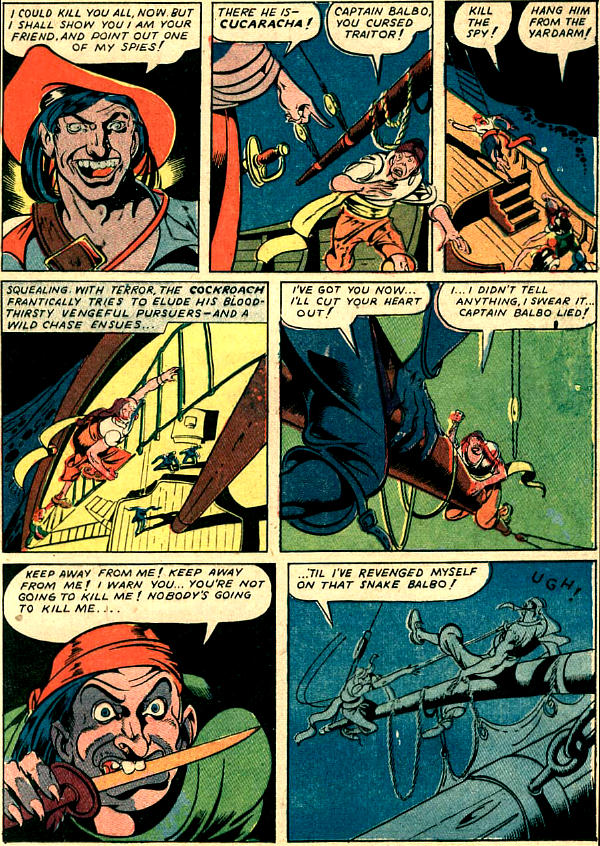
Arrrr! Hangman talks like a pirate today


September 19 is Talk Like A Pirate Day. Here at Pappy's we like pirates and like to arrrrrrgghhh along with Robert Newton in Treasure Island.

This Hangman story is from Hangman #8, Winter 1942-43. But the pirates are from 1498. You'll just have to read the story, because I can't explain it. All I can say is, it's vintage Golden Age comics. It's drawn by Bob Fujitani, signing himself Bob Fuje. He's drawing in his early style. Within a few years he'd adopt a more realistic, illustrative style. As you can see from some of the panels, a lot of his influence for the drawing in this story came from Will Eisner.

After you've read the story, mateys, swing your cutlasses, shake your pirate booty and holler arrrrrgghhh in honor of Talk Like A Pirate Day.


Thanks to 1506NixNix for the scans.
More about →

Người đăng: Unknown on Thứ Hai, 17 tháng 9, 2007


Number 190


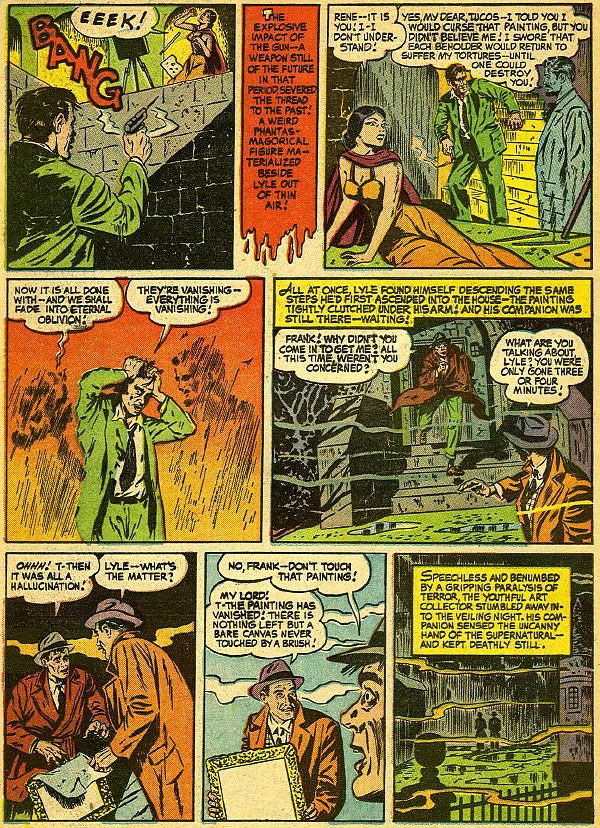
Sheldon Moldoff takes us through the Doorway to Horror!


When I first encountered organized comics fandom in its early phase, 1961, there was a focus on the DC superhero comics of the early '40s, specifically All Star Comics, and Max Gaines' All-American line of DC's superheroes. Sheldon "Shelly" Moldoff, who was born in 1920, was one of the earliest of the stars of DC Comics, drawing lots of covers but best known in 1961 for the work he had done 20 years prior on Hawkman. He was revered for Hawkman. He used a lot of swipes from Alex Raymond's Flash Gordon, but to be fair, everybody swiped. At the same time he was being revered for that earlier work, he was being reviled for his then-current work, as Bob Kane's ghost on Batman. The fans who loved his stuff didn't know he was the same guy they hated.


If you read Moldoff's version of things, he was an idea man as well as an artist. He came up with the idea for horror comics, pitching the idea to Bill Gaines, who--according to Shelly--took the idea and ran with it, leaving Moldoff drinking from his cup of bitter gall.* Oh well…you win a few, you lose a lot. Moldoff took his ideas to Fawcett, and after EC's horror comics took off, Fawcett published his horror stories.

This story, "Doorway to Horror," from Fawcett's Worlds Beyond #1, dated November, 1951, is a fairly typical story, but it's a good solid entry in the horror comics annals.

Shelly also drew the cover. Click on it to see it full size. It illustrates a story done by Bob Powell and posted in Pappy's #110.

Sheldon Moldoff was one of the cartoonists who made the Golden Age what it was. He and his peers worked hard for little money, they made their deadlines, they weren't flashy, but they were professional and dependable. In my opinion, "Doorway to Horror" is one of Shelly's better jobs. I think he enjoyed the horror work, the deep shadows, the whole noir atmosphere. It may have been in an artistic sense what would have attracted him to Batman.


*Tales Of Terror!/The EC Companion By Fred von Bernewitz and Grant Geissman, Fantagraphics Books, 2000.
More about →

Người đăng: Unknown on Thứ Sáu, 14 tháng 9, 2007


Number 189


How I went Mad in the 1950s


As a kid I never kicked and fussed when Mom took me to the grocery store, because it gave me a chance to stand near the magazine rack and paperback book spinner, ogling the sexy covers. On one occasion in 1955 or thereabouts I spotted a book I'd never seen before, The Mad Reader.

I opened it up to the first panel of Wally Wood's "Superduperman" story, and the rest, as they say, is history.

The problem is, as much as I wanted this book, and I wanted it really, really bad, Mom wouldn't buy it for me. Mom was aware of the talk about evil comic books turning children into juvenile delinquents, and while she let me read comic books she approved of (Uncle Scrooge, Little Lulu, etc.), she wasn't about to let me go over the line to something like Mad.

I went home disappointed, then my obsessive-compulsive disorder kicked in. When I wanted something as bad as I wanted this book I usually kept up a whining, obnoxious pleading until my parents caved in. Since Mom had said no, I went to my dad. Dad was usually more easygoing when it came to things like this. Listening to me bellow, snivel and whine for about an hour was all it took. He went to the store to find the book for me.

It's said that Mad, in its original comic book incarnation, was a flop saleswise until issue #4, which had the Wood "Superduperman" story. From that time on Mad became a cult favorite. Even my future brother-in-law, who was in in high school in the early '50s, bought Mad, as did his buddies. Mad was real gone! It was hep! I didn't know any of that, though. I just knew that I recognized who Superman was, I knew who the Lone Ranger was, I knew the comic book character, Archie, and I loved the grotesque, funny artwork of Wally Wood, Bill Elder and Jack Davis. They took all of those familiar characters and turned them inside out and upside down. They turned them into jokes. From that book I went on to the other Mad paperbacks, like Mad Strikes Back, Inside Mad, and Utterly Mad. From the time I first held these books I was hooked, a junkie to the drug of Mad-ness.

Mom's problem with Mad was the effect the drawings had on her, which was the exact opposite of the effect they had on me. She claimed they "made her head spin." They did that to me, too, just in a good way.

Take "Starchie, "Bill Elder's version of Archie. The art is very close to the original. The people who produce the Archie comics like to tout their comics as being wholesome, but there was no doubt that the whole subtext of their comic books was some sort of triangular sexual thing going on between Archie, Betty and Veronica. The author and editor of Mad, Harvey Kurtzman, always went for the most obvious satirical elements of what he was lampooning, and that is the crux of this story, behind its more obvious elements of Starchie and gang as juvenile delinquents.

The Lone Ranger was a guy who traveled around with a Native American companion and wore a mask. As in this Mad version called "The Lone Stranger," he steered clear of womenfolk. One might ask why? And did he and Tonto share body heat around the campfire? Anyway, when I saw this Jack Davis panel of the Lone Stranger being chased by the ugly "girl," I laughed my guts out. Yes, the lady chasing the Lone Stranger is actually a man in drag.

I was a big fan of Mad in the 1950s, but the two entities, the Mad paperback books and the regular Mad, magazines being published every couple of months, were entirely different things. I wondered why, but didn't know why they were different until later when I found out about the two editors, first Kurtzman, then Al Feldstein, about the Comics Code, about the color comic book after 23 issues becoming a 25¢ black and white periodical. Much to my mom's displeasure, despite a lot of yelling, burning my magazine collection, and even her outright theft of mail-ordered copies of early Mad comic books, I didn't give up on Mad.

What happened to me with The Mad Reader, I'm sure happened with a lot of people in my generation: aspiring cartoonists, comedians, actors, whoever. Who knew that such brilliance could exist in parody and satire? Looking back on that book today I still see the sort of genius I saw many years ago the first time I pulled it off the paperback rack.


*The copy of The Mad Reader at the top of this page is not my original Mad Reader, which was destroyed by my mother at some point in the late 1950s. This is a copy of a first printing I picked up in California 20 years ago.

More about →