I have read in several different places that Julius Schwartz had a file in his desk which proved that DC comics featuring apes on the cover sold better in general than comics without simians. I believe that Schwartz even mentioned this in his autobiography, Man of Two Worlds. It has also been claimed that to avoid overexposure, the number of ape covers was strictly limited by DC management to one per month.
This latter claim has never made a lot of sense to me. If your objective as an editor or a publisher is to sell as many comic books as you can (and I suspect that is, or ought to be the goal), then why would you refrain from doing something that has been proven to work in the past? And DC generally published 30 comics a month, would two gorilla covers really saturate the market?
So I decided to take a look at the matter. I started with 1960 and used the DC Indexes Time Machine to look at all the covers for a given month quickly. Note that the default option is for comics on sale in a given month, not cover dates. It seemed reasonable to use that option, since the concern was not to have to many ape covers on the newsstands at once.
First observation: If DC was worried about saturating the market with similar covers, it sure doesn't show. In 1960, as many others have noted, DC had an almost endless variety of covers featuring aliens, monsters and dinosaurs. It was not until looking at comics on sale in April that I located an ape cover:

Okay, so it's a gorilla; I suspect that Schwartz meant ape as a very generic term. The next month featured one of DC's most famous apes:
 After an absence of apes in June, July included an alien ape:

DC then resisted the siren call of the apes until December:
 Strange Adventures thus becomes the first series to hit two apes in one year.
And then came 1961. I am astounded to report that I can find no comics that went on sale from DC in that year which included apes, gorillas, or monkeys on the cover. There appears to be only one sensible conclusion; at this point, Schwartz had not yet developed his evidence about simians on the cover boosting the sales.
In January 1962, Grodd made his first cover appearance:
 This is further evidence that Schwartz had not yet discovered the link between sales and gorillas, as Grodd had appeared four times already inside the comics.
The following month saw the debut of Bizarro Titano:

After three months's hiatus, a simian was prominently featured on the cover of Batman Annual #3:

And once again, there was a gap all the way to March 1963. You might think it would be hard for Tomahawk, a revolutionary-era hero to encounter an ape. You would be wrong:
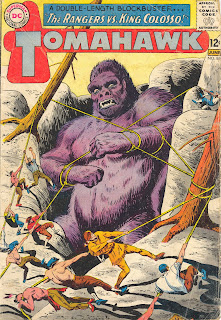 In June of that year, we got one of the classic ape covers:

Let me tell you, if an gorilla is sliding into third base, it's a pretty brave fielder standing there waiting for the throw.
Grodd popped up on the first Flash Annual in August:
 And the Great White Ape appeared in October's Star Spangled War #111 that same month, the first time we've seen two in the same calendar period.
But that's it for 1963. Monsieur Mallah appeared on the cover of Doom Patrol #86 in January 1964:

Tomahawk's giant ape returned in May:
 But then there was another gap until November when Jerry Lewis #86 featured a King-Kong type cover. In December there were two ape covers: Hawkman #6 and Fox and Crow #90.
By this point I was getting pretty skeptical. Out of 60 months and about 1800 comics, only 16 covers had featured an ape or a gorilla. And 1965 was not much different, with only two ape covers.
Ah, but then came 1966, and suddenly the African invasion. In January, came Strange Adventures #186:
 In February there were two covers:
 And Monsieur Mallah appeared on the cover of Brave & Bold #65.
After a couple months gap, an ape popped up on Sea Devils #30 in May, and Bob Hope #100 in June. Nothing for July, but August saw Hawkman #16, September had King Colosso yet again in Tomahawk (this time shooting a bow and arrow no less), October had Jimmy Olsen marrying a female gorilla, and November's Showcase #66 had Bwana Beast duking it out with an ape. All told, there were nine different covers with the simian theme in 1966.
And if you think about it, it makes sense that the editors at DC were pulling out all the stops that year. Although the company as a whole did well with Batmania, the gains were very uneven. Batman sales skyrocketed, but the Superman-related titles all dipped as did many other books.
In 1967, there were seven more ape-featured covers, with only two coming in one month: September had Jerry Lewis 103 and Plastic Man #7.
Overall impressions:
1. The number of ape covers do not seem excessive. However, there certainly was a jump in 1966-67; those two years saw as many of those covers as had been seen in the six years previous.
2. There is little evidence for a hard and fast rule against two ape covers in one month. There were three months where apes did appear on two covers. I suspect that the real edict was not to overdo it.
In 1968, the number of simian covers did drop, at least until this series launched:

More about →
This latter claim has never made a lot of sense to me. If your objective as an editor or a publisher is to sell as many comic books as you can (and I suspect that is, or ought to be the goal), then why would you refrain from doing something that has been proven to work in the past? And DC generally published 30 comics a month, would two gorilla covers really saturate the market?
So I decided to take a look at the matter. I started with 1960 and used the DC Indexes Time Machine to look at all the covers for a given month quickly. Note that the default option is for comics on sale in a given month, not cover dates. It seemed reasonable to use that option, since the concern was not to have to many ape covers on the newsstands at once.
First observation: If DC was worried about saturating the market with similar covers, it sure doesn't show. In 1960, as many others have noted, DC had an almost endless variety of covers featuring aliens, monsters and dinosaurs. It was not until looking at comics on sale in April that I located an ape cover:

Okay, so it's a gorilla; I suspect that Schwartz meant ape as a very generic term. The next month featured one of DC's most famous apes:


DC then resisted the siren call of the apes until December:

And then came 1961. I am astounded to report that I can find no comics that went on sale from DC in that year which included apes, gorillas, or monkeys on the cover. There appears to be only one sensible conclusion; at this point, Schwartz had not yet developed his evidence about simians on the cover boosting the sales.
In January 1962, Grodd made his first cover appearance:

The following month saw the debut of Bizarro Titano:

After three months's hiatus, a simian was prominently featured on the cover of Batman Annual #3:

And once again, there was a gap all the way to March 1963. You might think it would be hard for Tomahawk, a revolutionary-era hero to encounter an ape. You would be wrong:


Let me tell you, if an gorilla is sliding into third base, it's a pretty brave fielder standing there waiting for the throw.
Grodd popped up on the first Flash Annual in August:

But that's it for 1963. Monsieur Mallah appeared on the cover of Doom Patrol #86 in January 1964:

Tomahawk's giant ape returned in May:

By this point I was getting pretty skeptical. Out of 60 months and about 1800 comics, only 16 covers had featured an ape or a gorilla. And 1965 was not much different, with only two ape covers.
Ah, but then came 1966, and suddenly the African invasion. In January, came Strange Adventures #186:


After a couple months gap, an ape popped up on Sea Devils #30 in May, and Bob Hope #100 in June. Nothing for July, but August saw Hawkman #16, September had King Colosso yet again in Tomahawk (this time shooting a bow and arrow no less), October had Jimmy Olsen marrying a female gorilla, and November's Showcase #66 had Bwana Beast duking it out with an ape. All told, there were nine different covers with the simian theme in 1966.
And if you think about it, it makes sense that the editors at DC were pulling out all the stops that year. Although the company as a whole did well with Batmania, the gains were very uneven. Batman sales skyrocketed, but the Superman-related titles all dipped as did many other books.
In 1967, there were seven more ape-featured covers, with only two coming in one month: September had Jerry Lewis 103 and Plastic Man #7.
Overall impressions:
1. The number of ape covers do not seem excessive. However, there certainly was a jump in 1966-67; those two years saw as many of those covers as had been seen in the six years previous.
2. There is little evidence for a hard and fast rule against two ape covers in one month. There were three months where apes did appear on two covers. I suspect that the real edict was not to overdo it.
In 1968, the number of simian covers did drop, at least until this series launched:


