Number 1261: “. . . with the speed of protons — America's protector!”

Người đăng: Unknown on Thứ Hai, 12 tháng 11, 2012

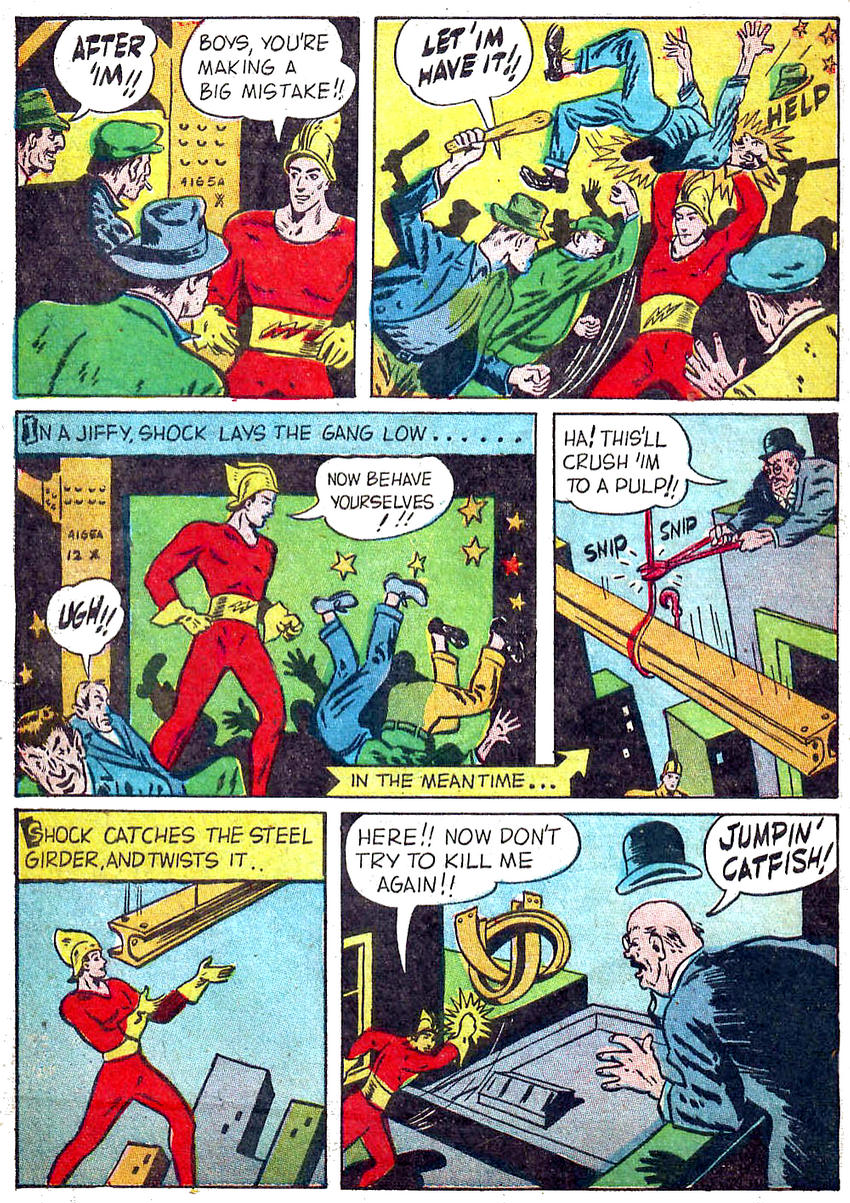
As I promised yesterday, here is a later, better drawn version of Shock Gibson than the crudely done origin from Speed Comics #1.

Bob Fujitani was always one of the slicker illustrators in comics, and worked on a variety of features for several companies. He worked in comics virtually his whole career.

In this story, from Speed Comics #41, published by Harvey Comics in late 1945 with a cover date of January, 1946, World War II still raged several months after it ended in the real world. That was the problem of comics drawn well in advance of their on-sale dates, and even affected some newspaper comic strips, which were drawn many weeks or even months before their publication. The Japanese are still undefeated and still treacherous, even co-opting the Hindu god, “Vishnu,” for their nefarious ends. Just another culture crime by comic book publishers, for whom religious deities not common in the United States were often portrayed in some insulting fashion.

 Vishnu
My apologies to those who may be offended.

In the story Shock Gibson's name is not Charles Gibson, as in the origin story, but Robert Gibson. He has dropped the odd-looking helmet and put on a mask. I don't know why someone didn't put together that Shock Gibson and Corporal Bob Gibson were the same person.

I've also included the Heritage Auction scans of the original art for “The God of Steel.”


More about

Lois Lane's "Fictional" Adventures

Người đăng: Unknown on Chủ Nhật, 11 tháng 11, 2012

From Lois Lane Annual #1, comes this list of "famous" old Lois Lane tales:
Why the scare quotes? Well, it turns out that a few of these stories never existed. Action Comics #20 is the January 1940 issue, and the (untitled) Superman story in that issue has Superman dealing with a headstrong actress; Lois doesn't even appear in there.  The May 1944 issue of Superman is #28, and it doesn't include any story with Lois on Krypton; at that point Superman didn't even know the name of his home planet.

Lois did not commit any crimes, perfect or flawed in the November 1945 issue of Superman, although she did meet a modern Annie Oakley in May 1951 (Superman #70).  She was featured in Mrs Superman (Superman #76) and wanted in Action #195, and had six lives in Action #198 and X-ray vision in Action #202.  The stories listed in the Showcase tryouts and Lois's own magazine are real, so overall, there were three stories (the first three) that never existed, out of the fifteen.

And, oddly enough, that turns out to be pretty good as the next Lois Lane Annual had seven phony baloney stories:

The others ["Lois Lane's College Sweetheart" (Action Comics, March 1939); "Lois Lane on Krypton" (Superman, May, 1944); "Lois Lane's Super-Dream" (Superman, August, 1945); "Lois Lane in Smallville" (Superboy, July, 1945); "The Girl of Gold" (Action Comics, June, 1952); "When Lois Met Green Arrow" (Adventure Comics, December, 1952); and "The Luck of Lois, Lana and Lori!" (Showcase No. 8)] were invented for this list for reasons that will almost certainly remain unknown.
Well, my guess is that Weisinger just didn't care if he got that list right; back then the assumption was that nobody would ever check this stuff.  There are some pretty obvious problems with the above list: Superboy didn't have his own magazine until 1949, and Showcase #8 was a Flash issue, not a Lois Lane tryout.
More about

Number 1260: The Human Dynamo!

Người đăng: Unknown

Charles “Shock” Gibson was born in this story from Speed Comics #1 (1939), one of those wildly improbable origins found in superhero comic books. A splash of chemicals, a bolt of lightning, and ZAP! Charles becomes superhero Shock Gibson, the human dynamo.

Shock's colleague, Dr. Blitzer, who witnesses Shock's new abilities, tells him he has “the strength of a thousand men!” Being a clean-cut American scientist of the fair play persuasion, Shock decides to use his powers for good, instead of for bagging chicks (I made up that last part). Anyway, his first adventure, 25 pages worth, moves like the comic book's title promises. Shock chases villains who are in an airplane, bounding his way across America to the Rocky Mountains. There he encounters a mad scientist. The scientist produces some zombies, but such zombies as you and I have not before seen.

I've mentioned before how the standards for comic book artwork changed rapidly from these early days, after the field exploded in popularity in the wake of Superman's success. A few years later Shock joined the military and was fighting the Japanese, and had artwork much elevated from his origin. Tomorrow I'll show you a story where Shock has a different costume (no sharkfin helmet, but an added mask), and the advantage of art by the terrific Bob Fujitani.


More about

Number 1259: Kirby's commie kickass character

Người đăng: Unknown on Thứ Sáu, 9 tháng 11, 2012


So many great characters came from Jack Kirby it’s hard to pick a favorite. But if I had to pick favorites, Fighting American, created by the partnership of Kirby and Joe Simon, would be right near the top. I assume that the pair were attempting to re-capture the lightning in a bottle they’d conjured up with Captain America over a decade before. It's too bad Fighting American, the comic book, didn't last longer than it did, because it had all the elements that should have made it successful: action, humor, good stories, and did I mention action? Oh yeah, Kirby's dynamic artwork, and the Fighting American bashing America's enemies!

I believe Fighting American had less of a fighting chance on the crowded comic book racks of its era, and even superheroes couldn't slug their way out of the distribution problems. Simon and Kirby's foray into publishing came to an end, and so did Fighting American. (...to be revived briefly with reprints in the sixties from Harvey Comics,  in a 1989 hardcover edition by Marvel Comics reprinting the series in its entirety, and more recently in a trade paperback from Titan Books.)

I have shown Fighting American before, last year, in Pappy's #1017.

“Assignment: Investigate the City of Ghouls” is the cover story from Fighting American #2, 1954:


More about

Walt Simonson's First Published Work?

Người đăng: Unknown on Thứ Tư, 7 tháng 11, 2012

From Magnus, Robot Fighter #10, May 1965, about 8 years before his first official work for DC (Weird War Tales) and about the same amount of time before his famed work on Manhunter, one of my favorite series of all time.
More about