Number 1345: Frontier Frazetta

Người đăng: Unknown on Chủ Nhật, 7 tháng 4, 2013

The world lost a great artist when Frank Frazetta died. For most people his work probably represents heroic fantasy, but a very important aspect of his artistic development was his early work in comic books.

Frazetta did these Dan Brand and Tipi stories for The Durango Kid comic book from ME in 1950 and ’51. His stories are usually why collectors want these comics. The artwork in the rest of the comic is well done, but just doesn't come up to Frazetta’'s level. That would have been true in any comics where his work appeared.

From The Durango Kid #4, 6 and 9:

DK #4:


DK #6:


DK #9:


**********
 'Taint the Meat...It's the Humanity: Fantagraphics does Jack Davis Tales From the Crypt stories


I received the Fantagraphics volume of Jack Davis stories from Tales from the Crypt pictured above. I have several copies of these classic EC stories in other formats, including the original comic books of the fifties, but I always like seeing them. When I saw the book, though, I wondered that for the purposes of my review what would be my hook…what could I do to make relevant this new volume of stories, all of which have been reprinted several times in the past?

The answer was a quote on the back cover. George Romero, whose Night of the Living Dead introduced the flesh-eating living dead to modern horror, is quoted as saying, “I think a great part of my aesthetic in the genre was born out of EC rather than movies.” Couple this with the book arriving in my mailbox a day after the season finale of the hit TV show, The Walking Dead, and there was my hook. (Or would that be meathook?)

A line can be drawn from EC horror comics to The Walking Dead (which was a horror comic before it was a successful television series). Panels like these were seeds sown in the minds of others, eventually leading to to today’s entertainment.


Not every horror story is gruesome, and so it is with this volume. The subject matter is varied, the shocks well placed (usually in the last panel). The progression of stories shows Davis’ own progression as an artist. At the demise of EC in 1955 Davis was probably better known for his Mad artwork, and that, more than his horror stories, brought him eventually to huge success as an artist. As a matter of fact, Davis had some trouble with horror comics, or at least he claimed that in a panel discussion I attended with Kurtzman and Davis in San Diego in the mid-‘80s.


In recalling the furor over horror comics and eventual censorship Davis said, “I used to lie awake at night and wonder, did I cause all of this?” For any misgivings, though, Davis made his original mark in the humble comic book industry, drawing both horror and humor, and was propelled to world fame as an artist.

So far in this series from Fantagraphics there have been volumes by Harvey Kurtzman, Wallace Wood and Al Williamson, with Johnny Craig and Al Feldstein coming soon. I'd love to see a volume of stories by “Ghastly” Graham Ingels, who along with Davis, kept a lot of kids like young George Romero shivering under the covers when the lights went out.

The volume is well produced. The stories are reproduced in black and white so we can see every line Davis drew. The binding is permanent and the heavy paper stock won’t disintegrate on your book shelf. It’s available from your local comic book store, or from Amazon.com, Bud Plant or the publisher, Fantagraphics Books.

I wouldn’t be me if I didn’t point out what I found lacking. The issue numbers of the individual comics are listed in near-microscopic type on the copyright page. (Book designers, please have mercy on those of us with aging eyeballs). It would have been nice to see those issue numbers listed either in the table of contents or in a line on the first page of each story. And why not show Davis' TFTC covers, even in black and white? Other than those quibbles, this book gets a high recommendation from me.

More about

Some more Sunday Tarzan strips from Emile

Người đăng: Unknown on Thứ Bảy, 6 tháng 4, 2013

I am presenting a few more Tarzan strips sent to me by Emile.

S174 - Survive - 1989-06-04 (3016) to 1989-08-20 (3027) - 12 weeks

S175 - City of Lights, City of Darkness - 1989-08-27 (3028) to 1989-11-12 (3039) - 12 weeks

S176 - New Age - 1989-11-19 (3040) to 1990-02-04 (3051) - 12 weeks

S177 - In Forests Dark - 1990-02-11 (3052) to 1990-04-29 (3063) - 12 weeks

S178 - The Last of the Tribe of Kerchak - 1990-05-06 (3064) to 1990-07-22 (3075) - 12 weeks

These are all in the 12 week format, much like Doordarshan's serials which ran for 13 weeks!

All thanks and praise are owed to EMILE.

Enjoy
Venkit

P.S. Follow the instructions regarding download from SendSpace.
More about

RIP, Carmine Infantino

Người đăng: Unknown on Thứ Sáu, 5 tháng 4, 2013

One of the major talents of the Silver Age has passed.  Some of my favorite covers of his:

Here's a guide that Infantino created for Flash Annual #1:
Infantino called a famous meeting of DC's top brass together in 1968, where he presented them with his versions of several recent DC covers.  The bosses had to admit his takes were better than the originals, and as a result he was given the newly created position of Editorial Director.  A few years later he was promoted to Publisher.

But obviously it was his art that is his legacy.  I don't know where he ranks in terms of total number of comics pages created; I would guess he has to be in the top five, certainly in the top ten. 

More about

Number 1344: Jann’s jungle fever!

Người đăng: Unknown

We’re in the final day of our Jungle Jive theme week. Monday we had Atlas Comics’ Lorna, today we have Atlas’ Jann.

One thing you can say about Atlas, when they did jungle girls they used some of their top artists. Werner Roth did Lorna, and Jay Scott Pike, who later went into the pin-up art field a la Gil Elvgren, did Jann. In this particular story, from Jungle Tales #2 (1954), Jann faces a jungle fever, and even runs into a dinosaur! They gave us a lot for six pages.

A bonus tale I'm including today is from the same issue, a horror/jungle hybrid tale, featuring Waku of the Bantu. Waku goes against the golden age jungle comic pattern by being an African, not some caucasian interloper. It's credited by the Atlas Tales website to Fred Kida. It has that really obnoxious coloring job on the Africans, which is a sort of purple-gray. I don’t know what the problem was, but that sort of ashen color continued on into the sixties. I remember an African-American reader calling Marvel to task for the coloring in the letter column of an issue of Sgt Fury and His Howling Commandos.


More about

Number 1343: Sheena, I seen ya

Người đăng: Unknown on Thứ Tư, 3 tháng 4, 2013

This is the third entry in our Jungle Jive theme week.

When it came to blonde queens of the jungle, Sheena was the blondest and the queenest. She was the original, created by Will Eisner, with the beauty and attributes of female villains found in Eisner’s Spirit stories, wrapped in leopard-skins; a voluptuous woman holding court over her queendom of the jungle. Do not mess with Sheena, pal, because she will knock you out, then chase you off.

I wonder about her mate, Bob. I mean...Bob. My brother’s name is Bob. Bob is a perfectly good name, but to share a throne with a queen? Bob, King of the Jungle? I don’t think so. It’s no wonder Sheena keeps Bob kind of behind, under her protection. She is stronger, smarter and she has a wicked punch. She doesn’t need Bob to take care of the innumerable evil white men who invade her corner of the jungle. Unlike Greg, who is boyfriend to Lorna the jungle girl, whom we saw Monday, Bob isn’t a male chauvinist. He likes being submissive to his queen, and I’ve said this before: maybe a lot of guys who read Sheena during the '40s wished they had a big blonde woman to submit to. Perhaps a 6’2” Sheena could tuck me under her arm and swing me through the treetops. That wouldn’t be the worst way to spend a Sunday afternoon.

Drawn by Robert H. “Bob” Webb, from Jumbo Comics #127 (1949):


More about

Number 1342: Lorna the Jungle Girl kicks commie devil bird butt!

Người đăng: Unknown on Thứ Hai, 1 tháng 4, 2013

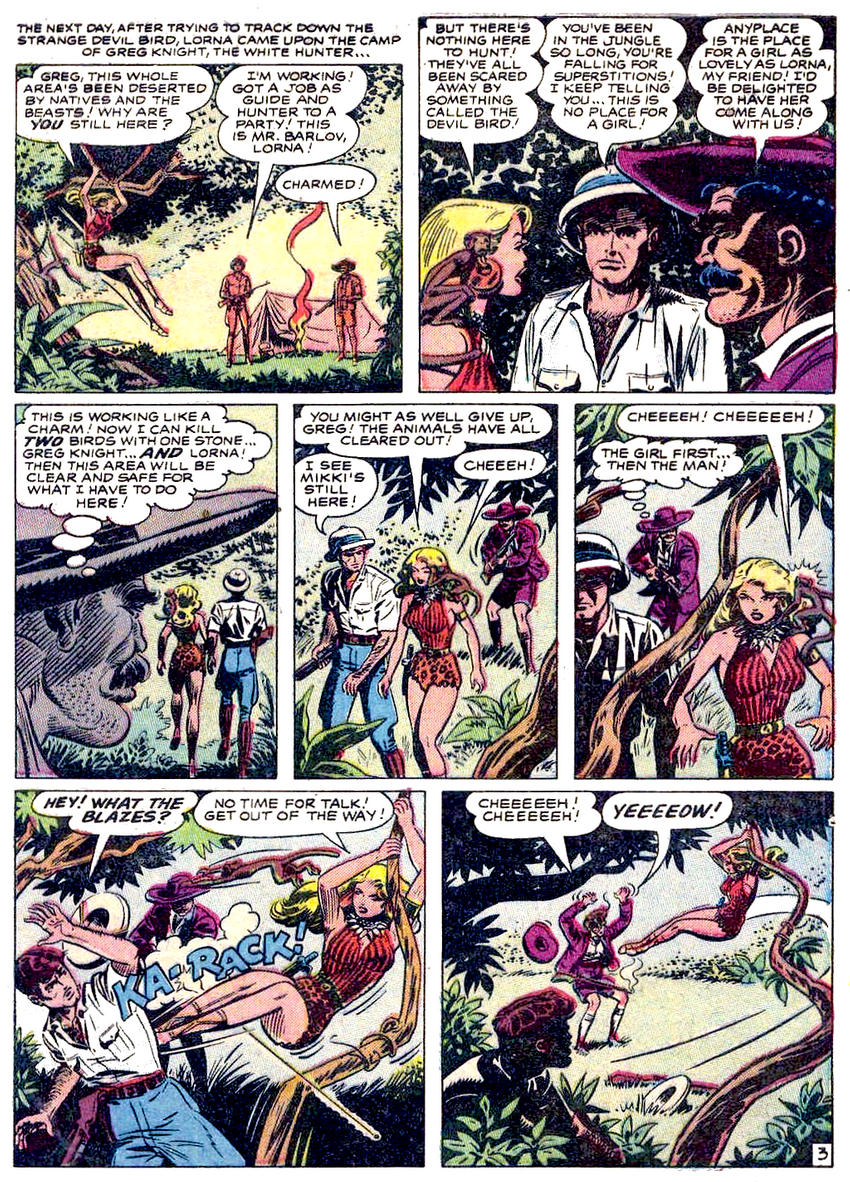
This is day two of our Jungle Jive theme week, here with the first of two postings featuring blonde jungle women. You’ll see Sheena on Wednesday, but for today you’ll be reading a couple of stories featuring one of Sheena’s competitors for the Miss Clairol of the Jungle award. Sheena came first, of course (created in 1938), but Lorna covered some of the same jungle territory. She protected the local tribes. She came up against constant menaces which she conquered handily. The difference in Lorna is in her man...Sheena’s man, Bob, is not a male chauvinist like Lorna’s Greg. That’s where the fun comes in. Greg is constantly telling Lorna men are superior to women, even after Lorna has pulled his sorry ass out of a deathtrap. Lorna smiles and goes along with Greg. I suppose she figures the guy is good for something, but considering his attitude we wonder what.

In these stories Lorna takes on communist infiltrators who come into the jungle trying to bamboozle the “superstitious natives”, and then, in the second story she channels some old jungle movies. She gives a Tarzan yell to keep dying elephants from trampling Greg.

It wasn’t the first time Lorna’s comic book creators borrowed an idea. In my last posting, Lorna dealt with a King Kong-size ape called Agu. At the bottom of the page you'll find a link to that post.

From Lorna the Jungle Girl #9 (1954). Art by Werner Roth, stories by Don Rico.


**********

Click pic to go to Pappy's #1143.


More about