See, there was the Golden Age Captain Marvel, aka Billy Batson, aka the Big Red Cheese. And Marvel came out with its own version of Captain Marvel, the man of the Kree who could change places with Rick Jones. And then there was this fella:

Captain Marvel is a robot who was created on another planet. His mission is to help others avoid the wars that destroyed his homeworld:

So you might say that he was a strange being who came to Earth with powers and abilities far beyond those of mortal men....
His origin is told in flashback like that, because his memory is faulty. In a robot? He has to recharge his powers every day by passing his hand over that M-shaped medallion on his chest. It turns out that he has a young friend:

We learn that he's a writer for an important press service, and that his next assignment is to cover a revolution in the Caribbean. His flight crashes en route in a jungle. Captain Marvel investigates the area and discovers:

Inside the computer are some giant heads, who initially seem like villains, but then it turns out that they just need Captain Marvel's help getting enough power so they can return to their normal dimension.
Comments: A padded, silly story, although I enjoyed the cartoonish artwork and the insane gimmick of him separating his body into multiple pieces. Like many superheroes, Captain Marvel picked up abilities as needed by the plot:

The second story is pretty much more of the same. Aliens (from Venus) who seem like villains but are really kind of ambivalent:
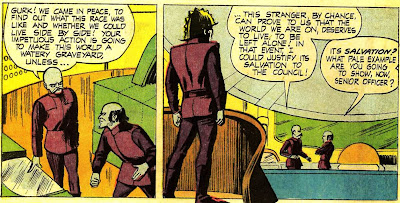
And how can Captain Marvel prove to them that humans deserve to live? Why by defeating the Venutians' nemesis, the Gronks. And the Gronks are the "Bonus Feature" shown on the cover, Plastic Man. But not that Plastic Man:

Captain Marvel defeats him by using another yet-unrevealed power:

So the Venutians decide that the humans are indeed worthy of living, and head back to their own planet. Plastic Man escapes, setting up a return match with that villain in the next issue. But is he really a villain, or yet another ambivalent antagonist?

Comments: I get the sense that the publisher was intentionally pushing the envelope on copyright/trademark here to find out what they could get away with. Captain Marvel was a former Fawcett character, who had been retired after he was ruled a violation of DC's copyrighted Superman. But DC had not perfected their rights to the character by trademarking the name, so it was apparently out there in the public domain. On the other hand, Plastic Man had definitely been purchased by DC, and so by the next issue he was renamed:

Note that the envelope is again being pushed by that issue with Atom-Jaw clearly a swipe of the longtime Lev Gleason character Iron-Jaw (also a mid-70s Atlas-Seaboard protagonist), and Dr. Fate a GA DC hero.
BTW, I found out about the Silver Age Captain Marvel at one of my regular blogs from the sidebar, but I can't remember where; somebody wrote about him within the last two months or so and intrigued me enough to track down this issue. I'd be happy to link that blog, but I really can't remember where I heard about him. Anybody? Bueller? Update: Jim pointed me to Gorilla Daze, where Allan wrote about the other other Captain Marvel a few months ago. Update II: Booksteve also covered the faux Captain Marvel just last week.
More about →

Captain Marvel is a robot who was created on another planet. His mission is to help others avoid the wars that destroyed his homeworld:

So you might say that he was a strange being who came to Earth with powers and abilities far beyond those of mortal men....
His origin is told in flashback like that, because his memory is faulty. In a robot? He has to recharge his powers every day by passing his hand over that M-shaped medallion on his chest. It turns out that he has a young friend:

We learn that he's a writer for an important press service, and that his next assignment is to cover a revolution in the Caribbean. His flight crashes en route in a jungle. Captain Marvel investigates the area and discovers:

Inside the computer are some giant heads, who initially seem like villains, but then it turns out that they just need Captain Marvel's help getting enough power so they can return to their normal dimension.
Comments: A padded, silly story, although I enjoyed the cartoonish artwork and the insane gimmick of him separating his body into multiple pieces. Like many superheroes, Captain Marvel picked up abilities as needed by the plot:

The second story is pretty much more of the same. Aliens (from Venus) who seem like villains but are really kind of ambivalent:

And how can Captain Marvel prove to them that humans deserve to live? Why by defeating the Venutians' nemesis, the Gronks. And the Gronks are the "Bonus Feature" shown on the cover, Plastic Man. But not that Plastic Man:

Captain Marvel defeats him by using another yet-unrevealed power:

So the Venutians decide that the humans are indeed worthy of living, and head back to their own planet. Plastic Man escapes, setting up a return match with that villain in the next issue. But is he really a villain, or yet another ambivalent antagonist?

Comments: I get the sense that the publisher was intentionally pushing the envelope on copyright/trademark here to find out what they could get away with. Captain Marvel was a former Fawcett character, who had been retired after he was ruled a violation of DC's copyrighted Superman. But DC had not perfected their rights to the character by trademarking the name, so it was apparently out there in the public domain. On the other hand, Plastic Man had definitely been purchased by DC, and so by the next issue he was renamed:

Note that the envelope is again being pushed by that issue with Atom-Jaw clearly a swipe of the longtime Lev Gleason character Iron-Jaw (also a mid-70s Atlas-Seaboard protagonist), and Dr. Fate a GA DC hero.
BTW, I found out about the Silver Age Captain Marvel at one of my regular blogs from the sidebar, but I can't remember where; somebody wrote about him within the last two months or so and intrigued me enough to track down this issue. I'd be happy to link that blog, but I really can't remember where I heard about him. Anybody? Bueller? Update: Jim pointed me to Gorilla Daze, where Allan wrote about the other other Captain Marvel a few months ago. Update II: Booksteve also covered the faux Captain Marvel just last week.


