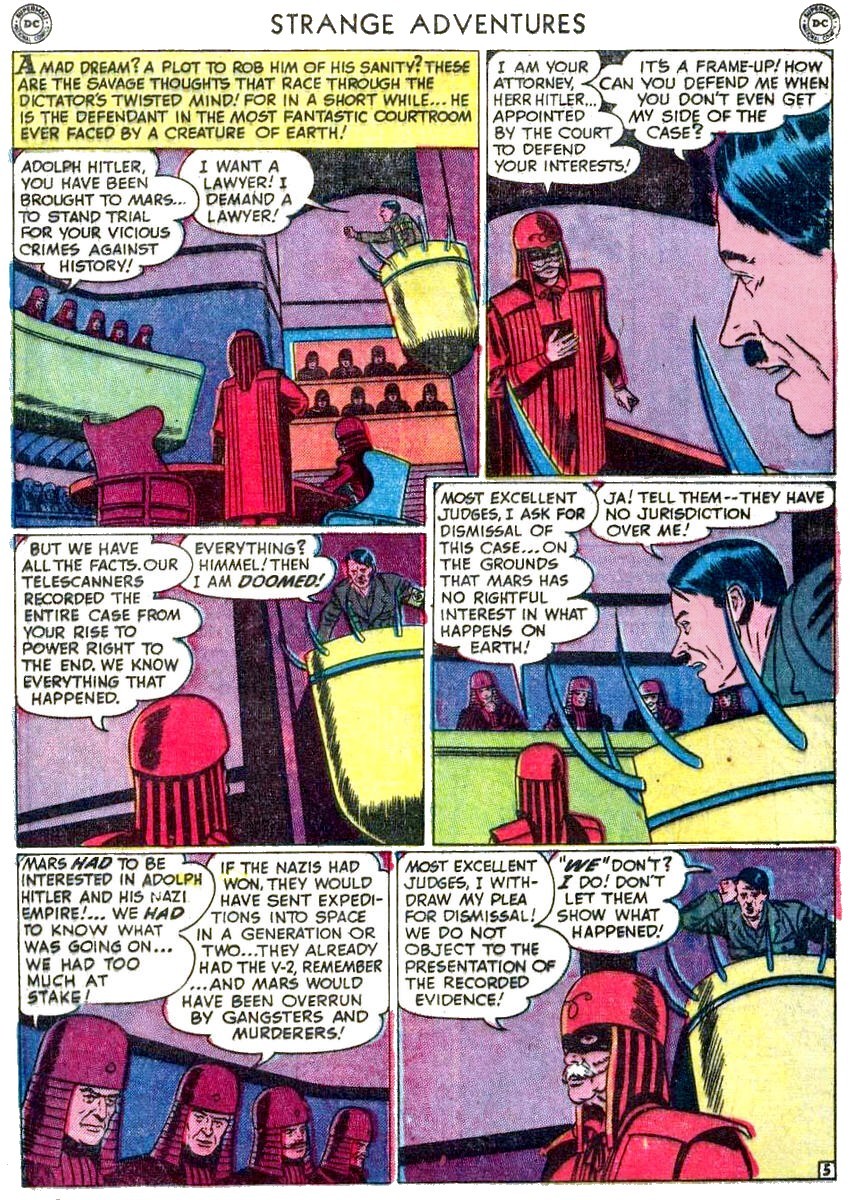
Number 1163: The Secret Fate of Adolph Hitler!

Người đăng: Unknown on Thứ Sáu, 25 tháng 5, 2012


I've shown several stories over the past couple of years showing what "really" happened to Hitler. Because his body was recovered near his Berlin bunker by the Russians there was always a suspicion that Hitler had gotten away from the allies, and was still alive somewhere. If he was alive, he might be plotting a comeback. And so it goes. It was a perfect theme for postwar fiction, including comic books.

This particular tale, written by Horace Leonard ("H. L") Gold, was drawn by Curt Swan and inked by Jon Small. I don't know about your sense of fictional revenge, but the ending just doesn't seem either ironic nor punishment enough. Hitler was, after all, someone who enjoyed the sound of his own voice.

Gold did scripting for DC from 1942 to '44, went in the Army, and did some more comic scripting for a few years. He also wrote science fiction and fantasy prose, and is probably best known for founding and editing Galaxy Science Fiction, beginning in 1950 (the year this story was published). Here's a scan of the cover of Galaxy #1, which I picked up in a used bookstore a few years ago.


According to biographical information, Gold, who was born in 1914, suffered later in life from agoraphobia, and became reclusive. He died at age 81 in 1996.

From Strange Adventures #3 (1950):


***********

I'm debuting a new masthead next Friday, June 1, and here's a preview.

I've adapted the cover of Red Seal Comics #14, published by Harry "A" Chesler in 1945. The hero barging in at just the nick of time, the Black Dwarf, wasn't black, and he wasn't a dwarf. He was Shorty Wilson, an ex-pro football player without super powers who hated crime. He put on the cloak and hat and strapped on a gun.

I looked at hundreds of covers and panels and settled on this one. The cover is reminiscent of great pulp magazine covers with similar themes: sex, bondage, a mad doctor and a hip-shootin' hero! Paul Gattuso, the artist, isn 't a household name, but he was one of the journeymen comic book artists of the era.

More about

Number 1162: Dan Gordon was a dang fine cartoonist

Người đăng: Unknown on Thứ Tư, 23 tháng 5, 2012

 Dan Gordon, who sometimes signed his name dang, was a talented animator and comic book artist who worked for ACG on their humor books. Cookie is a funny Archie-style teenage comic. Gordon's fluid drawings move the eye quickly across and down the page (a good example is page six of "Cookie's Oil Company," in a borderless sequence of Cookie sleepwalking). To show his technical drawing ability, page four features a large bird's-eye view perspective drawing.

You can find some more examples of Dan Gordon's work in Pappy's #796 (with a short bio of Gordon, and a story of Cookie in drag), and a Superkatt funny animal story in Pappy's #506.

Cookie's Pop is a great example of how Gordon could draw anger. Poor Pop looks like he's about to have a stroke. Those of us pappies who raised teenage sons remember the feelings Pop goes through in this story. I also love Gordon's funny little bearded guy, Pete.

From Cookie #6 (1947):


The inside cover features a subsidiary character seen in a couple of panels in the above story:


More about

D2-068 - "Food Ship” (9/28/66 to 2/11/67)

Người đăng: Unknown on Thứ Ba, 22 tháng 5, 2012

Almost 16 and half months ago, I received it with 4 spanish pages (18, 19, 20, and 21). Thanks to team effort, we are reading complete story today.
  • Scans contributor: Wichien Abhichartvorapan
    Spanish pages were scanned by him.
  • Translation team: Emile, Wichien Abhichartvorapan & Venkitachalam Subramanian
  • Strips texts replacement: TPH
----------------
Story: Harry Harrison 
Art: Dan Barry
Original run:  9/28/1966 to 2/11/1967
Summary: Relaxing after his tumultuous time on the planet Ognom (Read D2-067 Ming IV), Flash is ordered to urgently pilot a supply ship to the planet Titan in the wake of two previous relief ships disappearing without trace.
Starting out on the crucial mission, it is not long before Flash’s ship also exhibits disturbances and is inexorably drawn towards a sector in space that goes under the name of “Sargasso in Space”...
(Source of summary: www.ipcomics.net)

Download (29.4 MB)
More about

Number 1161: Joe Certa's vampire and werewolf

Người đăng: Unknown on Thứ Hai, 21 tháng 5, 2012

Joe Certa, another journeyman comic book artist who began his career in the 1940s, was the longtime artist on "J'onn J'onzz, Manhunter From Mars" for DC, and was also drawing for Gold Key in the '60s. The fine work he'd done for Harvey's horror comics in the '50s put him in good stead with GK titles like Boris Karloff Tales of Mystery and Ripley's Believe It Or Not.

These two shorts, "The Vampires" and "The Monster of Auvergne," are both from Ripley's #4 (1967). Since Gold Key wasn't covered by the Comics Code Authority they could show vampires and werewolves, which were prohibited at the time by the CCA. (The Code restrictions were lifted eventually, when the little kids who were being "protected" from such mythical creatures in the late '50s and '60s were either going to college, or even if still young, had seen much worse on television.) Certa's "Vampire" came out just about the time the story of the "original" Dracula, Vlad the Impaler—well known in Eastern countries—was beginning to become known to Westerners. Certa apparently used no references when he drew the historical panel of "Drakula."

Certa was born in 1919, and died in 1986.


More about

Number 1160: Jesse Marsh's Dinosaurus!

Người đăng: Unknown on Chủ Nhật, 20 tháng 5, 2012

Artist Alex Toth wrote about Jesse Marsh, longtime artist on Tarzan and Gene Autry Comics: "[Marsh] lived in Monrovia, California, with his aged parents, and took care of them to the last. Upon their passing, alone, middle-aged, he went on working hard, despite failing eyesight due to his bout with diabetes — and, in fact, died unattended in that family home — where he was found days later."*

Marsh died in 1966. He gave up drawing Tarzan in '65 due to his health problems.

Dell Four Color #1120, Dinosaurus!, from 1960, is a Jesse Marsh job. He did the drawing and lettering.** It's tragic, a guy and a drawing board, so isolated he was dead for several days before his body was found. Some of the artwork in Dinosaurus is rushed, but even so his composition is solid. Despite his problems Marsh was still a professional.


*See the whole essay, hand-lettered by Toth, here.

**Credit in the Grand Comics Database, via Alberto Becattini, is given to Eric Freiwald and Robert Schaefer for the writing. It's an adaptation of a movie I haven't seen, but you can read the IMdB posting here.

Here's an ad from the June 13, 1960 issue of Life magazine.

More about